


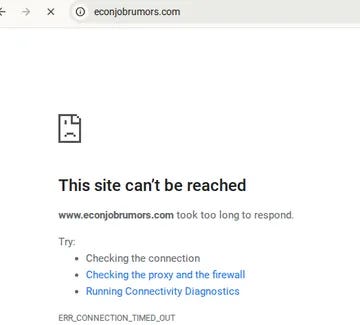
Econ Job Market Rumors—the internet’s deranged, occasionally brilliant, and for years indispensable backchannel for the economics profession—has been down for several weeks. The owner isn’t responding to emails. At this point, it looks like EJMR may be gone for good.
At its peak, EJMR really was the beating heart of the economics profession. Beneath the trolling, cruelty, and rampant mental illness, was an extraordinarily useful venue for anonymous discussion of the job market, department politics, hiring rumors, academic scandals, and research misconduct. Important stories routinely surfaced there long before they reached the rest of the profession.
But the site had been dying for years.
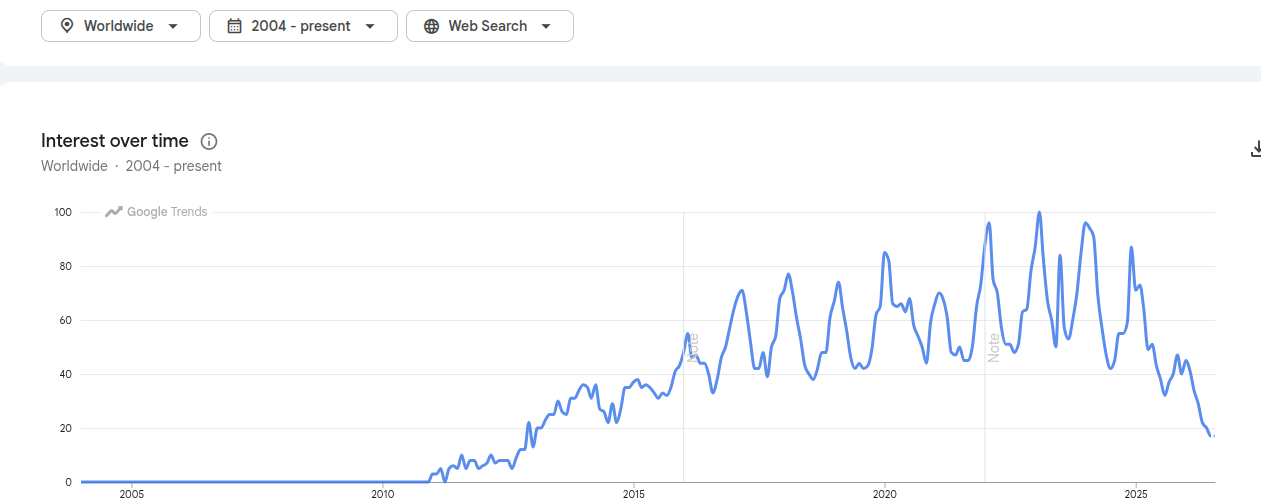
According to Google Trends, interest in the site peaked in 2022, the same year ChatGPT was released. Since then, it has become unusable. There were still occasional nuggets of genuinely valuable information, but almost every thread was buried beneath repetitive trolling, automated posts, and obvious LLM-generated spam. Finding anything worthwhile meant digging through pages of garbage. By the time it died, much of what made EJMR useful was already gone. All of the economists who actually wanted to talk about economics had already been driven away by the spam.
Careers were made—and destroyed—on EJMR, mine included. Most famously, it was an EJMR user who emailed me the plagiarism allegations that ultimately helped bring down Harvard president Claudine Gay. Another writer who came up on the forum was Noahpinion, who spent years hanging around EJMR before becoming one of the most successful economics writers in the world.
For all its ugliness, the forum allowed information to escape institutions that had every incentive to keep it contained. Graduate students could talk about abusive advisers. Junior faculty could discuss department politics. Researchers could flag suspicious papers. Job candidates could compare notes about hiring. People who would never attach their names to an accusation against someone at Harvard, MIT, Stanford, or Chicago could at least put the information somewhere public.
Now much of that information simply won’t come out. Without an anonymous public forum, uncomfortable allegations and embarrassing facts are far more likely to remain private, controlled by the very people and institutions with the strongest incentives to suppress them.

There will almost certainly never be another EJMR.
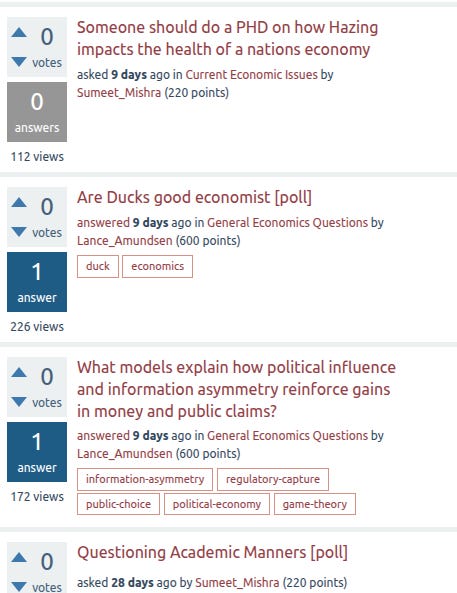
The American Economic Association famously spent hundreds of thousands of dollars building EconSpark, an official attempt to usurp EJMR. It went nowhere. Nobody used it, in large part because it was tightly moderated and institutionally sanitized. The AEA had every incentive to protect the profession’s reputation, not to host the kind of anonymous, adversarial discussion that might expose its dysfunction, scandals, or corruption.
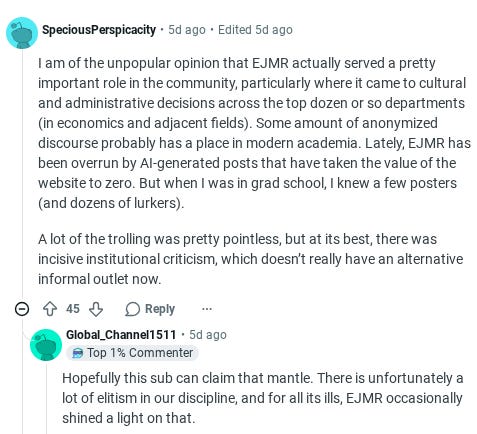
The people on /r/academiceconomics seem convinced that some cleaner, friendlier, better-moderated replacement will reign on Reddit. It won’t. The thing that made EJMR valuable was also the thing that made it hated: radical anonymity combined with extremely permissive speech rules. A forum where graduate students can anonymously accuse powerful professors of misconduct will inevitably also contain lies, grudges, trolling, and offensive garbage.
Reddit is structurally hostile to that model. Between sitewide rules, moderators, voting, account bans, and reputational incentives, genuinely controversial, novel, or explosive claims (and especially anything even remotely right-wing) are deleted instantly. Reddit, a tightly sanitized liberal echo chamber, owned by Condé Nast, hates free speech.
EJMR took the opposite approach: let people speak. That was EJMR’s uncomfortable bargain: protecting the freedom to say important things also meant protecting the freedom to say awful and stupid ones.
And in the end, the thing that may have killed EJMR was not censorship but the opposite problem: too much speech that was no longer human. LLMs made it nearly costless to flood an anonymous forum with endless garbage. The old EJMR could survive trolls because trolls at least had to spend time trolling. Once anyone could generate thousands of posts at effectively zero marginal cost, the signal-to-noise ratio collapsed.
The internet is now approaching an impossible tradeoff. Moderate aggressively enough, and you create sterile platforms where the most controversial speech is filtered out before anyone can judge its value. Moderate too little, and bots, spam, and AI-generated sludge make genuine human conversation impossible to find.
That messiness is the price of genuine free speech. Free speech matters precisely because nobody gets to decide in advance which speech will turn out to matter.
Maybe the solution is to do substantially all of the censoring on the front end (i.e., filter for nonhuman traits at account creation/modification rather than on a post-by-post basis)? My fun way to do this would be to require the registrant to post something racist, but CAPTCHAs and the like would also probably work.
Hate to hear that. May have only known about them through you because I don't travel in those circles, but when some site dies, I know the sense of loss.