


The executives of Owens Corning—an American company that produces insulation, roofing, and fiberglass—knew for decades that their asbestos manufacturing plants were killing workers. By the late 90’s, they were embroiled in thousands of asbestos lawsuits. To resolve these lawsuits, Owens Corning entered Chapter 11 bankruptcy in October 2000 under the weight of billions of dollars in present and future asbestos liabilities.
Then the vultures arrived.

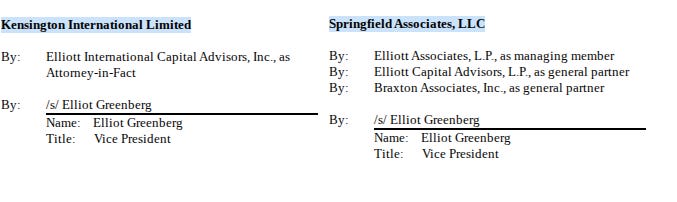
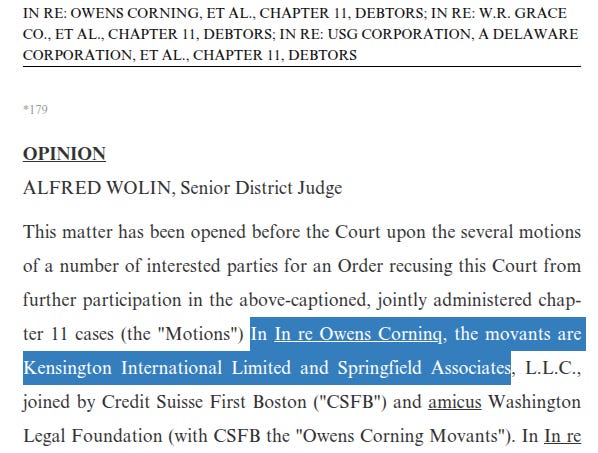
Soon after declaring bankruptcy, “sometime that summer” of 2001, Paul Singer, through two Elliott Management (his hedge fund) subsidiaries (Kensington International and Springfield Associates), became the single largest holder of Owens Corning’s bank debt and began operating as a “movant” in the bankruptcy case , meaning he sought to influence restructuring, settlement, and liquidation decisions.
Singer understood a cold financial truth: cutting the company’s asbestos payouts would immediately raise the value of the bank debt he controlled. In effect, every dollar denied to a sick worker coughing up blood was a dollar transferred directly onto his balance sheet.
To execute this extraction, Singer launched a multi-front campaign spanning courtrooms, Capitol Hill, and public media.
If asbestos workers couldn’t breathe, it’s because the judge was biased.
If asbestos workers couldn’t breathe, it’s because tort laws were wrong.
If asbestos workers couldn’t breathe, it’s because they were lying, vexatious, fraudulent grifters.
By poisoning the well, the narrative shifted public and legal focus away from corporate negligence toward claims of systemic fraud by victims, laying the groundwork for severe restrictions on who could qualify for compensation.
The Manhattan Institute was contacted for comment prior to publication.
No response was received by the time of publication.
Elliott Management was contacted for comment prior to publication.
No response was received by the time of publication.
This publication is 100% reader-supported and free from corporate sponsors. To keep these deep-dive investigations coming, please consider becoming a paid subscriber.
Here is a 15% off coupon to incentivize you to subscribe:
Campaign Against the Judge
Elliott’s first move was to launch a campaign to remove Senior District Judge Alfred M. Wolin from supervising Owens Corning’s asbestos bankruptcy.
Wolin appointed five outside advisers with experience in asbestos litigation to help him manage the cases. Two of those advisers were simultaneously representing asbestos claimants in an unrelated asbestos bankruptcy.
Elliott petitioned the Third Circuit for a writ of mandamus ordering Wolin’s disqualification from the bankruptcy case due to this “conflict of interest.”
Wolin then produced a 102-page opinion refusing to recuse himself, finding no appearance of impropriety, and arguing that the petition had been motivated by strategy rather than ethics.
In May 2004, a divided Third Circuit panel ruled 2–1 in Elliott’s favor and removed Wolin from the Owens Corning bankruptcy. The majority stressed that it had found no actual bias, wrongdoing, unethical conduct, or partisanship by Wolin. It removed him because the advisers’ conflicting roles “created an appearance under which his impartiality could reasonably be questioned.” The dissent argued that no meaningful conflict existed. Contemporary reporting described it as “highly unusual” for financiers to become so directly involved in removing a judge.
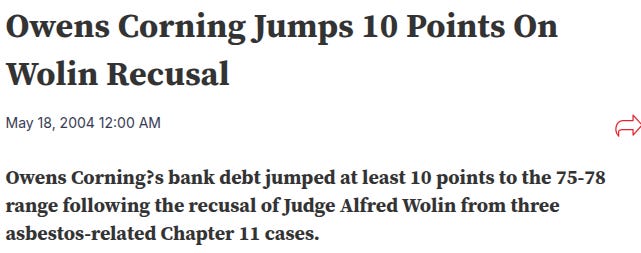
Whatever the legal merits, the financial markets understood immediately who had won. Owens Corning’s bank debt jumped by at least ten points, to roughly 75–78 cents on the dollar. Just three weeks earlier, it had traded from the high 50s to the low 60s. The ruling therefore added hundreds of millions of dollars to the expected value of the company’s bank debt—and, on paper, to the value of Paul Singer’s position. Investors were betting that Wolin’s replacement would give greater weight to the claims of bank lenders over bondholders and other creditors.
PR Campaign
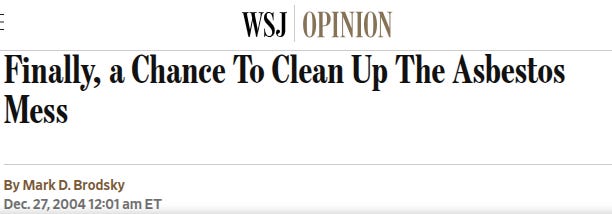
A few months after this court victory, Mark D. Brodsky, Elliott’s senior portfolio manager and the executive centrally involved in the Owens Corning strategy, published a Wall Street Journal op-ed titled “Finally, a Chance to Clean Up the Asbestos Mess” where he presented asbestos bankruptcy as a system distorted in favor of claimants’ lawyers.

Over the following years, asbestos defendants, insurers, creditors, and their political allies developed an elaborate narrative about fraudulent “asymptomatic” claimants. Once dying claimants were smeared as healthy opportunists recruited by crooked lawyers, reducing their compensation could be sold as “tort reform” rather than what it was: a transfer of money away from injured workers and toward corporations, insurers, and distressed-debt investors.
Singer and Elliott Management were among the largest corporate donors to federal political campaigns, political action committees, and conservative policy groups lobbying for this “tort reform.”
That was the trick: turn the people dying from asbestos exposure into the villains of the asbestos scandal.
A central player in this strategy was the Manhattan Institute.
The Manhattan Institute Pushed This Rhetoric
Singer’s relationship with the Manhattan Institute overlapped almost perfectly with Elliott’s battle over Owens Corning.
October 5, 2000 — Owens Corning enters Chapter 11 bankruptcy under the weight of its asbestos liabilities.
2001–2002 — Elliott Management becomes a major holder of Owens Corning’s distressed bank debt.
May 2, 2002 — The Manhattan Institute launches dedicated programming on asbestos litigation.
2003 — Singer begins documented financial support for the Institute. The Paul Singer Family Foundation gives $90,000 to the Manhattan Institute.
May 2004 — Singer joins the Manhattan Institute’s board, at the height of Elliott’s fight over the Owens Corning bankruptcy.
2004 — Singer’s foundation increases its contribution to $150,000.
May–October 2006 — Owens Corning reaches its restructuring agreement and emerges from bankruptcy.
February 21, 2008 — Singer becomes chairman of the Manhattan Institute.
Singer-controlled foundations have donated at least $13.5 million to the Manhattan Institute since 2003, according to publicly available tax records.
A search for “asbestos” on the Manhattan Institute’s website returns 102 results, heavily concentrated around the years surrounding the Owens Corning bankruptcy fight. They hosted conferences, published reports, produced commentary, and promoted scholars who repeatedly depicted asbestos plaintiffs as medically unimpaired opportunists, recruited claimants, and outright fraudsters.

Here are just a few examples from the more than 100 asbestos-related articles, reports, and events published or hosted by the Manhattan Institute:
Asbestos Litigation: Malignancy in the Courts?” (2002)
“asbestos law was applied to cases of dubious injury and ultimately to cases . . . with no injury”
“Why is asbestos litigation increasing at a time when medical science says it should be decreasing? It is because asbestos litigation today has come to consist, mainly, of non-sick people, suing in jurisdictions where asbestos litigation is one of the main industries supporting the local economy”
“Asbestos litigation is putting many small firms with no history of negligence out of business, destroying jobs and setting dangerous new court precedents.”
“the asbestos-litigation plague works its mischief”
“the asbestos-litigation whirlwind—reveal the trial lawyers to be not the champions of ordinary Americans, but their exploiters.”
Understanding Asbestos Litigation: The Genesis, Scope, and Impact (2003)
Toward Greater Judicial Leadership in Asbestos Litigation (2003)
“The sustained boom in asbestos litigation is happening, in large part, because trial lawyers began to actively recruit plaintiffs who, by any reasonable standard, are not sick”
'‘asbestos litigation is emerging as a prime threat to job creation”
“Owens Corning exhausted its assets and insurance paying claims. It was a very widespread problem”
“…lawmakers have long made it an annual habit to pass [bills] … the effect of which is variously to increase retroactively the level of [asbestos] damages plaintiffs’ can obtain in pending cases…”
“With asbestos, and many other mass tort episodes, a rash of arrestingly high verdicts helped educate recalcitrant defendants about the need to pony up substantial settlements.”
The Great Asbestos Swindles (2003)
““Issue one” for the new Congress should be the rescue of the U.S. economy from [asbestos lawsuits]”
“tens of thousands of claimants who were neither sick nor impaired but who won the asbestos lottery when mass x-ray screenings showed collagen deposits -- benign lung abnormalities related to many environmental causes --”
“Rampant fraud in asbestos litigation calls for a prosecutorial response.”
The Seven Myths of Highly Effective Plaintiffs’ Lawyers” (2004)
Plaintiffs’ attorneys run thousands of healthy people through medical mills and then enroll them in asbestos lawsuits … from asbestos alone, one could conclude that the tort system in America is dysfunctional in the extreme.
What Did Those Asbestos X-Rays Really Show? (2005)
“Asbestos litigation prevented the creation of 500,000 jobs”
“[Asbestos litigation] is a fraudulent scheme so massive as to qualify for entry into the pantheon of such great American frauds as Enron, WorldCom, OPM, Credit Mobilier and Teapot Dome.”
How a “Loser Pays” Rule Would Improve the American Legal System (2008)
“Mass tort litigation, for example, over asbestos, has been exposed as rife with fraud.”
In 2006, Manhattan Institute senior fellow James R. Copland testified before the United States House of Representatives Committee on Financial Services.

In asbestos litigation … those with no cognizable medical injury receive payouts from bankrupt firms and their successor trusts.
These outcomes are unsurprising. Mass tort cases, like asbestos, tend to overwhelm courts and are subject to abuse, even fraud … asbestos dockets are flooded with illegitimate claims
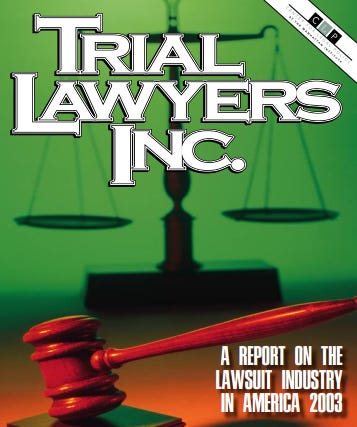
The Manhattan Institute’s Center for Legal Policy published several reports, including this one in 2003, which used the word “asbestos” 67 times and called asbestos litigation the “longest-running mass tort in U.S. history and arguably the most unjust.”
In 2008 they published another 32-page report that used the word asbestos 300 times, “A REPORT ON THE ASBESTOS LITIGATION INDUSTRY.”
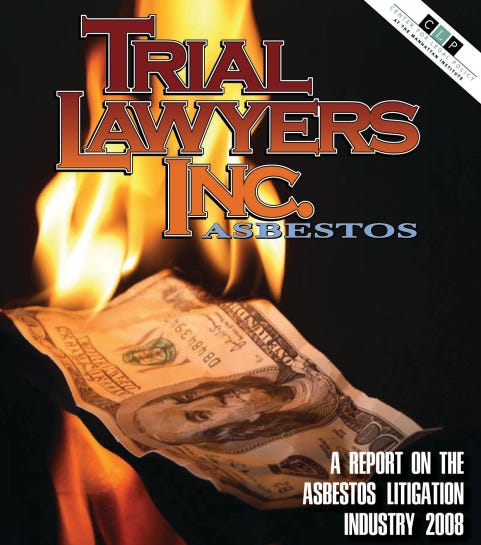
That report described:
Plaintiffs who “aren’t sick”
Lawyers recruiting “sham victims”
A “lawsuit assembly line”
Screening trailers in restaurant, motel, shopping-center and other parking lots
X-ray vans used to manufacture claims
Clerical workers preparing diagnoses that doctors allegedly rubber-stamped
Claims based on “fraud, corrupt experts [and] perjury”
Legislative Lobbying
By 2015, the Manhattan Institute’s talking points had become congressional findings. A House Judiciary Committee report devoted an entire section to asbestos “fraud,” mass recruitment, medically unimpaired claimants, lawsuit assembly lines, free X-rays, and screening vans parked outside union halls, restaurants, and hotels.
The report cited the Manhattan Institute itself as evidence that asbestos defendants needed greater protection from claimants.
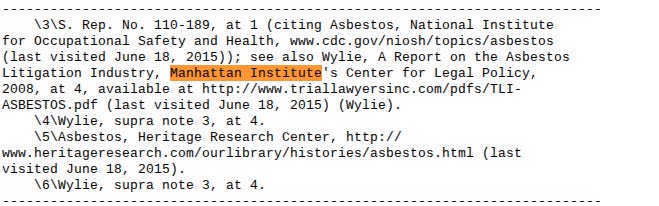
It also cited Manhattan Institute scholar Lester Brickman fourteen times—including to support claims explicitly involving Owens Corning, the asbestos manufacturer whose debt Paul Singer had acquired.
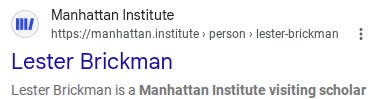
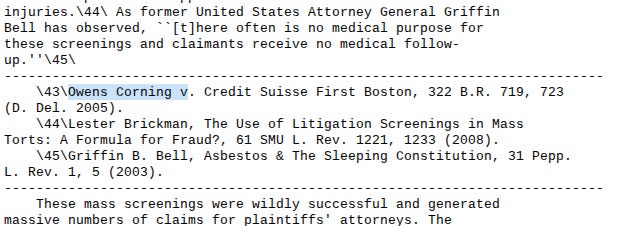
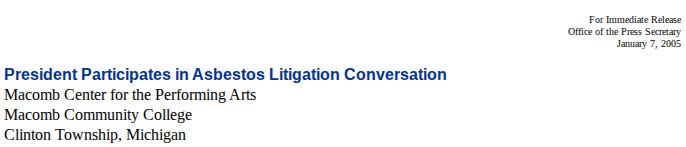
Brickman had already played a prominent role in the political campaign for asbestos reform. On January 7, 2005, President George W. Bush introduced him as an asbestos-litigation “expert” during a televised White House event at Macomb Community College.
Singer had personally contributed the legal maximum to Bush and bundled at least $100,000 more for his presidential campaigns.
Standing beside the president, Brickman claimed that, of roughly 850,000 asbestos claimants, “perhaps 600,000” had filed “largely baseless claims.” He alleged that many cases relied on questionable diagnoses and false testimony.

Brickman was a law professor, not a physician.
Journalist Greg Palast claims his asbestos research had been funded by Singer.
The “expert” was not a doctor, but notably, his “research” was partly funded by Paul Singer. And so was Bush. Since the death of Enron’s Ken Lay, Singer and his hedge fund crew at Elliott International have become the top contributors to the Republican National Committee. It’s hard to measure their largesse exactly, because some of that help comes in through the side door.
For example, in 2004, Singer put money behind the “Swift Boat” smear on Bush’s opponent for the presidency, John Kerry. The legal, political, and PR attacks on the dying workers chiseled away the compensation expected to be paid by the asbestos companies, boosting the firms’ net worth. Singer then flipped Corning, selling it for a neat billion-dollar profit.
It’s legal, it’s brilliant, it’s sick, it’s Singer
More Legislative Lobbying
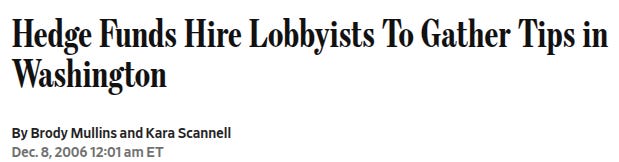
This wasn’t the first time that the Manhattan Institute had snuck their propaganda into the congressional record. A 2006 Wall Street Journal investigation reported that Elliott was among the hedge funds paying Washington lobbyists for political intelligence concerning proposed asbestos legislation working its way through Congress:
A contemporaneous profile of Elliott describes the firm as “invest[ing] a lot of time, effort and money in Washington, lobbying for “creative” tort reform laws that would help its case.”
“We saw that efforts to find a legislative solution to the asbestos litigation crisis were gaining traction,” said Singer. “We helped to form a financial industry coalition to support these efforts. We’ve tried to be helpful and creative, and we’ve invested a good deal of effort in the endeavour.”
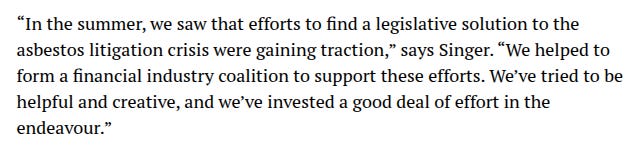
The “creative” coalition Singer was referring to was Financial Institutions for Asbestos Reform, or FIAR, a coalition of hedge funds and other investors with financial stakes in asbestos litigation.
Elliott paid FIAR approximately $80,000 a year in membership fees. In February 2006, FIAR sent Senators Arlen Specter and Patrick Leahy a letter attacking asbestos legislation. Senator Leahy subsequently entered FIAR’s letter into the Congressional Record.
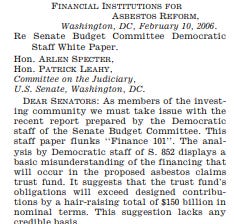
FIAR did not merely lobby Congress; it manufactured an economic rationale for doing so. In October 2003, it commissioned Navigant Consulting economist William O. Kerr to calculate an “asbestos litigation penalty.” Kerr claimed that failing to enact federal reform would cost the economy $2.4 billion and more than 30,000 jobs every year. Those figures were soon repeated on the Senate floor and recycled by tort-reform advocates across the country.

Navigant was not an arms-length academic institution: Federal lobbying records show that Navigant Consulting was registered to lobby for Paul Singer’s Elliott Associates from 2003 through 2006 on tort issues.
The Payoff
By the end of the fight, Elliott had operated on nearly every front. It fought the asbestos claimants in bankruptcy court. It ran a media smear campaign. It helped organize a coalition of financial institutions seeking federal asbestos legislation. And Singer himself acknowledged that Elliott had invested substantial “time, effort and money” lobbying Washington for tort-reform laws that would help its position in Owens Corning.
The stakes had been clear from the beginning. In February 2004, Judge Alfred Wolin wrote that Owens Corning’s bank lenders could recover nearly 100 cents on the dollar if they defeated substantive consolidation, while other commercial and personal-injury claimants stood to receive only fractions of their claims.
The lenders ultimately did even better than that.
Under Owens Corning's final reorganization plan, approximately $1.475 billion in bank claims were classified as unimpaired. The lenders were entitled to cash covering those claims plus default interest and fees. Owens Corning later reported that, when it emerged from bankruptcy on October 31, 2006, it paid approximately $2.405 billion in cash to holders of its prepetition bank debt.
The asbestos victims did not receive comparable treatment. Owens Corning's own bankruptcy disclosure warned that “Nothing approaching full payment” of its present and future asbestos claims was possible. Instead, victims were moved into a trust that assigned claims scheduled values based on eight disease categories and imposed medical and exposure requirements before applying a separate Payment Percentage to the value of each qualifying claim.
Even tens of thousands of victims whose claims had already been settled before the bankruptcy were caught in the new system. When Owens Corning filed Chapter 11, approximately 61,000 completed settlements remained unpaid in whole or in part. Owens Corning subsequently reported that it made virtually no asbestos-related payments throughout the bankruptcy. Under the final plan, those previously resolved but unpaid claims were themselves subject to the trust's Payment Percentage.
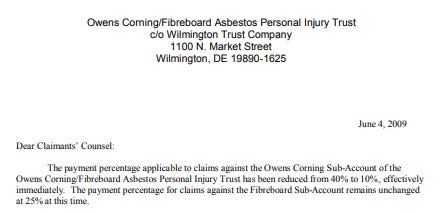
The Owens Corning Trust initially set that Payment Percentage at 40 percent.
On June 4, 2009, it slashed it to just 10 percent.
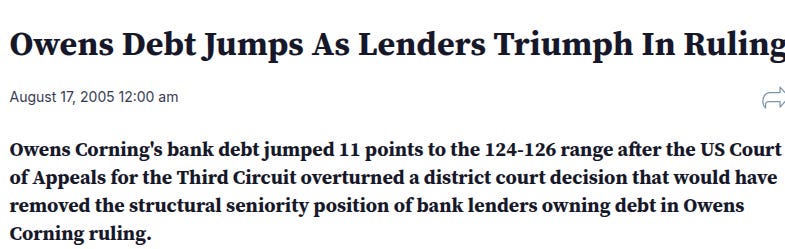
Elliott, meanwhile, had accumulated one of the largest positions in Owens Corning's distressed bank debt. We do not know precisely what Elliott paid for every piece of that debt, but the market prices illustrate the opportunity: Owens Corning bank debt traded at just 51–52 cents on the dollar in March 2001; after Paul Singer prevailed in court, the debt surged to 124–126 cents on the dollar.
Measured from those market prices, Owens Corning's bank debt — owned by Paul Singer — appreciated by roughly 143 percent.
Paul Singer was paid more than in full, while asbestos victims received as little as 10 cents on the dollar of the money they were owed. For many, the years of engineered court delays meant the checks arrived long after they had already died. And throughout the fight, the Manhattan Institute which Paul Singer funded, governed, and ultimately chaired, smeared the dying victims as the problem.
You are telling me a major funder of both Zionism and trans activism is not all that morally grounded a guy?
🤔
except two things can be true. There were a lot of marginal asbestos cases as well