


I’m competing in the Word War Debate Tournament, and I need your vote to advance to the next round of the bracket. You can vote for me at this link, voting is open for the next 48 hours:
The debate prompt was: Should Military Service Be Required to Vote?
The moderator is Ryan Mullally, a lawyer. He is a smart and fair guy and I like him a lot, please follow him on X and subscribe to his YouTube channel.
My opponent, Glenn Lawrence, is “an actor, podcast host, producer, and musician who is also known for his strong views on masculinity, relationships, and cultural issues.” He is a military veteran who argues that voting rights should be tied to military service. I defend universal suffrage and the status quo.
Watch:
I was far from perfect — the main reason I entered this tournament was simply to practice my public speaking, and I have a verrrry long way to go — but definitely did a better job than the other guy, who was fucking awful. He was dumb, loud and aggressive, and talked over me, which resulted in me freezing up 2-3 times, but that was something I can improve on with experience.
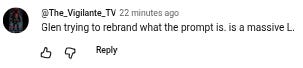
I think he knew he had a losing argument because for the whole debate he kept trying to shift the debate prompt from “military service” to “national service”.
Let’s walk through it.
Opening Statements
His 5 minute opening statement began with an ad hominem attack in the first sentence, then launched into an argument that voting is not merely a form of self-expression but an exercise of political power over other citizens.
Lawrence then repeatedly retreats from “military service” to the much broader idea of “national service,” implicitly conceding that military service itself has no unique claim. The list he gave as examples of “national service” that should qualify for voting was:
Law enforcement
Firefighters
FEMA / disaster-relief work
Conservation Corps
Peace Corps
He later argues this list should include architects because architects work to make sure “roads don’t collapse.” Setting aside for a minute that architects don’t work on the structural integrity of roads, if you are arguing that working as an architect at a private company qualifies as you to vote in a “Should Military Service Be Required to Vote?” debate, I think you have lost.
He also argues that surgeons should count. Again, if you are arguing that working a surgeon at a hospital in Vermont qualifies as you to vote in a “Should Military Service Be Required to Vote?” debate, I think you have lost.
So his position is much broader than the debate resolution.
My opening statement centers on constitutional principles, advocating for fair democratic participation while celebrating the vital contributions of everyday hard-working citizens—from farmers to healthcare workers—as the true backbone of the nation. Grounded in the wisdom of Founding Fathers like John Adams and George Washington, I emphasize governance by consent, equal representation for all taxpayers, civilian leadership, individual liberty, and human flourishing.
15 Minute Open Debate
Opens with a pedantic argument about how society requires drivers licenses in order to drive therefore we should require certification for voting. I argue that rather than mechanical skills like steering/breaking, the analagous situation for voting would be to test voters on e.g. macroeconomics, constitutional law, trade policy.
I argue that if 95% of society is banned from voting, they will feel disenfranchised and not feel like they have a stake in society.
Glenn: “Adding another prerequisite to vote DOES NOT eliminate 95% of the voting population.”
Chris: “How much does it eliminate?”
Glenn: “It requires a higher standard of entry to do so”
Chris: “Which would eliminate 95% of voters, right?”
Glenn: “No.”
Chris: “Who would it eliminate?”
Glenn: “The people who choose not to serve in the military”
Chris: “Presently that is 95% of the population.”
Glenn: “That’s a choice. They choose not to vote then.”


I argue that this voting reform would lead to more wars. He argues it would lead to less war.
He argues you shouldn’t be able to vote unless you have skin in the game and sacrifice for your country. I argue there are many forms of sacrifice.
I ask how this will impact society:
Chris: How do you think this will make society better? Do you think it will lead to better hospitals? Better schools? Better policy? What specific policy will improve?
Glenn: Yes
Chris: Which specific one?
Glenn: All of them
Chris: You think there would be no negative repercussions from disenfranchising 95% of the population? Which negative repercussions will there be?
Glenn: refuses to answer
I ask about brain drain
Chris: Do you think brain Drain would be an issue? All the most talented, all the PhDs and scientists, you don’t think they would have the country if they didn’t get to vote?
Glenn: I don’t know why they wouldn't be able to vote. They could join the service
I ask about blind, deaf, and disabled voters
Chris: What if you’re blind, or have epilepsy? And you want to serve your country but you’re not allowed to?
Glenn: A blind person can still serve
Chris: But somebody with epilepsy can’t serve in the military
Glenn: We can give them waivers. There’s a guy in the military now with no legs.
He argues for a military draft
Moderator Crossfire
We argue semantics about the debate prompt and whether “national service” (FEMA, Firefighters, Conservation Corps, Peace Corps, architects, surgeons) count as military service. I argue he is expanding it on purpose because the prompt is so indefensible.
I argue for universal suffrage, he argues that voting is a privilege
We argue about the draft
15 More Minutes of Open Debate
I ask him if a left-wing president rises to power, won’t they just choose and shape their own electorate by excluding e.g. unvaccinated, anti-trans, or anti-DEI people from military service, leading to permanent one-party rule?
He argues this can’t happen because “in my time in service I didn’t meet many left-wing people … I didn’t meet many people that were left-wing so I don’t think that would be a problem … I don’t see how [anyone in the military] will ever vote for a left-wing President.”
Chris: I just think you’re underestimating the capacity for a left-wing president. They’re shaping their own electorate, meaning they can pick who their voters are, and I really think that would lead to a one party state. And the right-wing would do the exact same thing. Donald Trump would pick his own electorate, and it would lead to a one-party state … what I am saying is that it would give the government the power to pick their own electorate.
Glenn: I don’t think so.
Chris: I think it’s absurd not to look at history and talk about military juntas, or left-wing Soviet politburos coming to power through the military. Like once they get control of who serves in the military and the military is who votes, it’s a dictatorship basically right away.
Glenn: It’s not a dictatorship. A veteran can vote against it.
Chris: Right but we’re talking about in thee future, like in 10 or 20 years.
Glenn: In the future, in 10 or 20 years from now, there’s going to be veterans. And they may not align with the government in power and they can vote him out.
…
Chris: Do you think that politicians will vote for larger military budgets if the people voting for them were only military?
Glenn: The defence budget would probably increase by some substantial amount … a good benevolent leader is not going to be ruling with an iron fist in one direction
Chris: In every scenario you’re talking about a benevolent perfect leader. But I’m talking about reality, where Kamala Harris could be president, or Bernie Sanders
Glenn: But that’s not reality because Kamala Harris is not president. If we’re going to talk about reality, use reality.
Chris: She’s currently leading the race for primaries to be the contender.
Glenn: She’s probably not going to win.
Chris: So we’re never going to have a left-wing president?
Glenn: If we implement my policy, probably not.
Chris: Right that’s what I’m saying. Your policy is going to lead to a one-party state, basically whoever is in power first gets to shape their electorate forever.
Glenn: No. No. Mine opens up a third-party option. I think your approach is narrow minded.
Chris: I would say that it’s narrow-minded to say that there’s never going to be a left-wing president who will use the weapons that you give them against you. I think it will backfire.
Glenn: Sure, maybe in a hypothetical reality. In reality I don’t see how that is going to happen.
Chris: In reality there is never going to be a left-wing president?
Glenn: It’s possible.
This was one of the funnier exchanges, about whether blind people can serve:

I then argue that the status quo (universal suffrage) is preferable to blowing up western civilization to run the most radical social experiment ever conducted.
Closing Statements
My statement was about the American people rising up to demand freedom, and then I invoke ancient Sparta, Starship Troopers, and end with an argument about Christian morality.
His closing statement is about duty and honor.
I need more practice.
I need your vote to advance to the next round:
I've been reading you for a long time and do appreciate your work.
I did enjoy the debate. Substantial food for thought.
Glenn was a bit of a jerk but he had some very good points, especially one about responsibilities.
Starship Troopers is A BOOK! By Robert Heinlein. And it is one of the best books ever written, not only as an s-f novel but in general, for S-F is a (great) vehicle for some deep philosophical and political questions, very relevant to the subject of the debate. Also Heinlein invented power armour in the same book. How cool is that? BTW the movie is great too, IMO.
Sorry, but your sappy emo argument "But the farmers! The farmers!" was weak.
Still you had some very good points. Especially regarding possible takeover/one-party state.
...
After careful consideration I gave you my vote but only cause you won.
Glenn lost when he changed the debate subject, period.
BTW I do think military service should be required for all voters ;] In my country not USA or Canada, of course.
You're both really dumb people. The difference was, he was assigned to defend an impossible position. Had luck gone the other way and instead you were given his side to argue, he would have mopped the floor with you.