


President Donald Trump’s proposed FY2027 budget seeks $1.45 trillion in defense spending, a 44% increase over the $1.009 trillion enacted for FY2026.
An expansion of this magnitude is difficult to understand as anything other than preparation for a potential World War, an enormous windfall for the military-industrial complex, or some combination of the two.
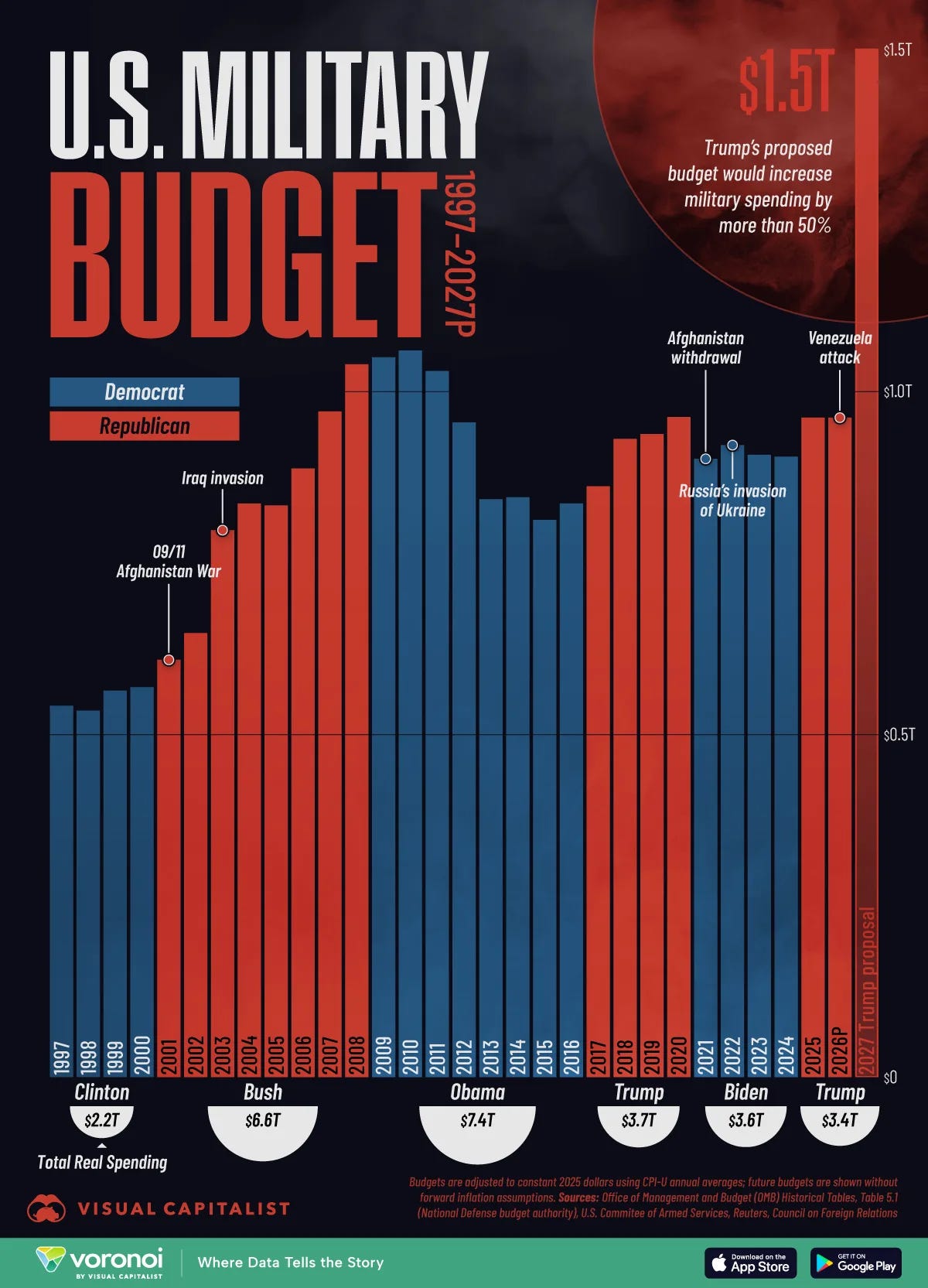
But the broader military buildup is not the focus of this article. Instead, I am examining a specific provision in the new defense budget bill known as the “United States–Israel Defense Technology Cooperation Initiative” (USITCI).
The USITCI appeared as Section 224 in earlier versions of the FY2027 National Defense Authorization Act (NDAA), but has since been renamed as Section 219.

If you are extremely online, you have probably already heard about this.
Perhaps you saw Dennis Kucinich discussing it with Tucker:
Or perhaps you saw it on someone else’s Substack:


But if you rely on mainstream media, there is a good chance you have not heard about it at all, and on the rare occasion it has received mainstream coverage, it has been framed as a good thing.
Origins
Today’s legislation is the culmination of a decades-long effort.


2020–2022. Congress authorized the creation of the United States–Israel Operations-Technology Working Group, whose purpose was “to identify military capability requirements common to the Department of Defense and the Ministry of Defense of Israel.”
2023: Congress attempted to expand this model through the United States–Israel Future of Warfare Act, which would have created a dedicated United States–Israel Future of Warfare Research and Development Fund.
2024: Pentagon establishes a partnership between the Defense Innovation Unit and its Israeli counterparts.
2025: The United States–Israel Defense Partnership Act sought to create a permanent Defense Innovation Unit office in Israel.
2025–2026: The FY2026 budget created a United States–Israel Defense Industrial Base Working Group with the mandate to “identify opportunities for deeper integration between the American and Israeli defense industries.”
The various strands were finally pulled together on February 12, 2026, with the introduction of the United States–Israel Framework for Upgraded Technologies, Unified Research, and Enhanced Security Act—the FUTURES Act.
The FUTURES Act proposed establishing a new United States–Israel Defense Technology Cooperation Initiative that would fold in Israeli technology to American military systems and coordinate activities across the Pentagon.
Senators Ted Budd and Kirsten Gillibrand introduced the Senate version, while Representatives Ronny Jackson and Don Davis introduced the House bill.

Neither the House nor Senate version of the FUTURES Act advanced out of committee… instead, the bill was folded almost verbatim into today’s budget, as the USITCI.
Is it Really a “Merger”?
Zionists will insist that the USITCI is not ~*technically*~ a merger, merely an expansion of military cooperation and a major step toward permanent integration.
Defenders compare this arrangement to standard NATO or AUKUS interoperability. But USITCI would establish a dedicated Pentagon Executive Agent charged with synchronizing, expanding and accelerating U.S.–Israel research, development, testing, integration and industrial cooperation. Under Pentagon rules, that agent’s assigned responsibilities would take precedence over those of other Defense Department component heads, giving it unusual authority to push Israeli technology through the department.


That semantic distinction is impossible to sustain.


Read the text of the bill for yourself:
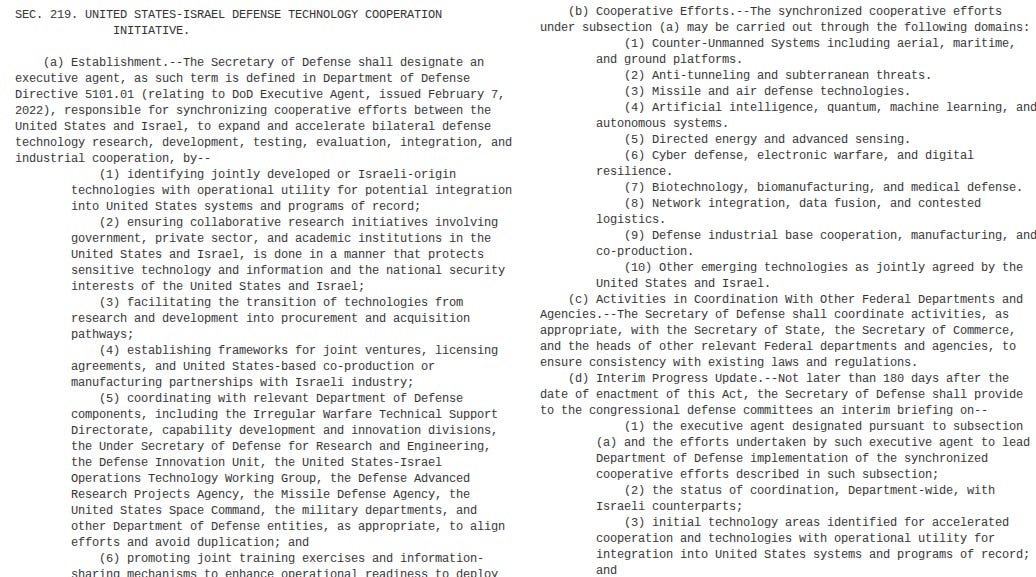
The bill directs the Pentagon and the Israeli Ministry of Defense to “align efforts and avoid duplication.”
That is the basic logic of any merger: eliminate overlapping functions, coordinate investments and divide responsibilities across a single integrated system.
If Exxon merged with Chevron, the combined company would not maintain two separate accounting departments merely to preserve the appearance of independence. It would consolidate “duplicated” functions. The same principle is at work here. The Pentagon and the IDF will now “avoid duplication” in:
manufacturing
missile defense
Space Command
drone fleets
directed energy
quantum computing
artificial intelligence
cyber warfare
biotechnology
Of particular concern is the listing of “biotechnology, biomanufacturing, and medical defense” as an area for joint research, given Israel’s failure to join the Biological Weapons Convention and longstanding rumors of an active biological weapons program on its part; information-sharing within this domain may breach US commitments under Article III of the Convention.
the overly broad category of “other Department of Defense entities, as appropriate”
The merger becomes even more explicit when the bill turns to “network integration” and “data fusion.” Satellites, drones, radar systems, intelligence databases and battlefield sensors will now all be designed to exchange and process data across a unified architecture — hence the word: “fusion.” There won’t be Israeli or American satellites, there will simply be ”fused” satellites.
A military that depends upon another country’s missiles, satellites, technology, data, factories, supply chains and drones is no longer operating independently in any meaningful sense. It has merged into one component of a larger system.
Deeper integration also means weaker oversight and less accountability. As personnel and systems become increasingly intertwined, it becomes harder to determine who is making which decisions, or even where American authority ends and Israeli authority begins. This gives Netanyahu undue influence over when, where, and how American military power is used.
Separately, it extends through 2029 an existing authority allowing the U.S. to transfer weapons already stored in its War Reserve Stockpile in Israel. That authority permits transfers without Congress voting on each shipment.
Co-Production and “Buy America” Bypasses
When the United States provides military aid to Israel, the standard defense is that the money supports American jobs because Israel is required to spend it on U.S.-made weapons.
But Israel already enjoys unusually favorable access to Pentagon procurement:
Historically, Israel enjoyed a unique exemption under Foreign Military Financing (FMF) called Off-Shore Procurement (OSP), allowing many Israeli defense products to receive exemptions from the Buy American statute.
Under the Defense Federal Acquisition Regulation Supplement (DFARS 225.872-1), Israel is explicitly designated as a "qualifying country", which grants exemptions from Buy American Act restrictions.
USITCI would deepen that subversion by helping Israeli-origin technologies move into American procurement programs. A weapon could now be assembled in a U.S. factory and marketed as American-made, even when the underlying factory, workers, technology, intellectual property, and profits belong to an Israeli company. USITCI would therefore undermine the competitiveness of the American private sector.
From Aid to Partnership
The U.S. has given Israel hundreds of billions of dollars in direct military aid over the past few decades.
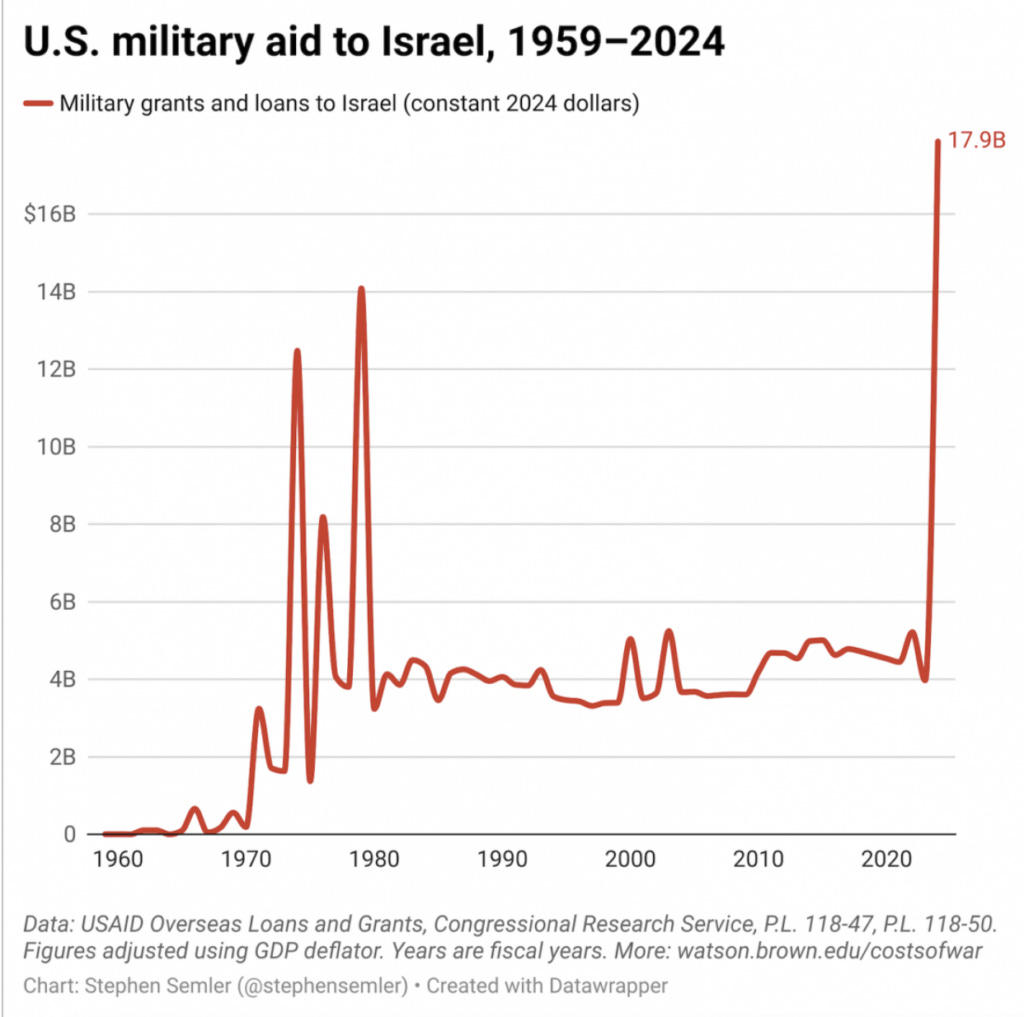
People are upset about that. So upset, that 60% of Americans now oppose sending arms to Israel, and 75% of Americans under 30 have unfavorable views of the country.
Faced with that backlash, pro-Israel influencers have recently coordinated to push a new damage-control line: “Fine—cut off the aid. We don’t want it anyway.”


The one leading this narrative is actually Benjamin Netanyahu himself.
Netanyahu is saying: “Keep your $3.8 billion. Let’s just merge our militaries instead.” He’s willing to walk away from a few billion in foreign aid if it means gaining a massive foothold into a $1.5 trillion pile of money. On June 1st, 2026, he put this plan in writing, sending a letter to Indiana Congressman Marlin Stutzman explicitly calling it “my plan to shift the framework from aid to partnership”:
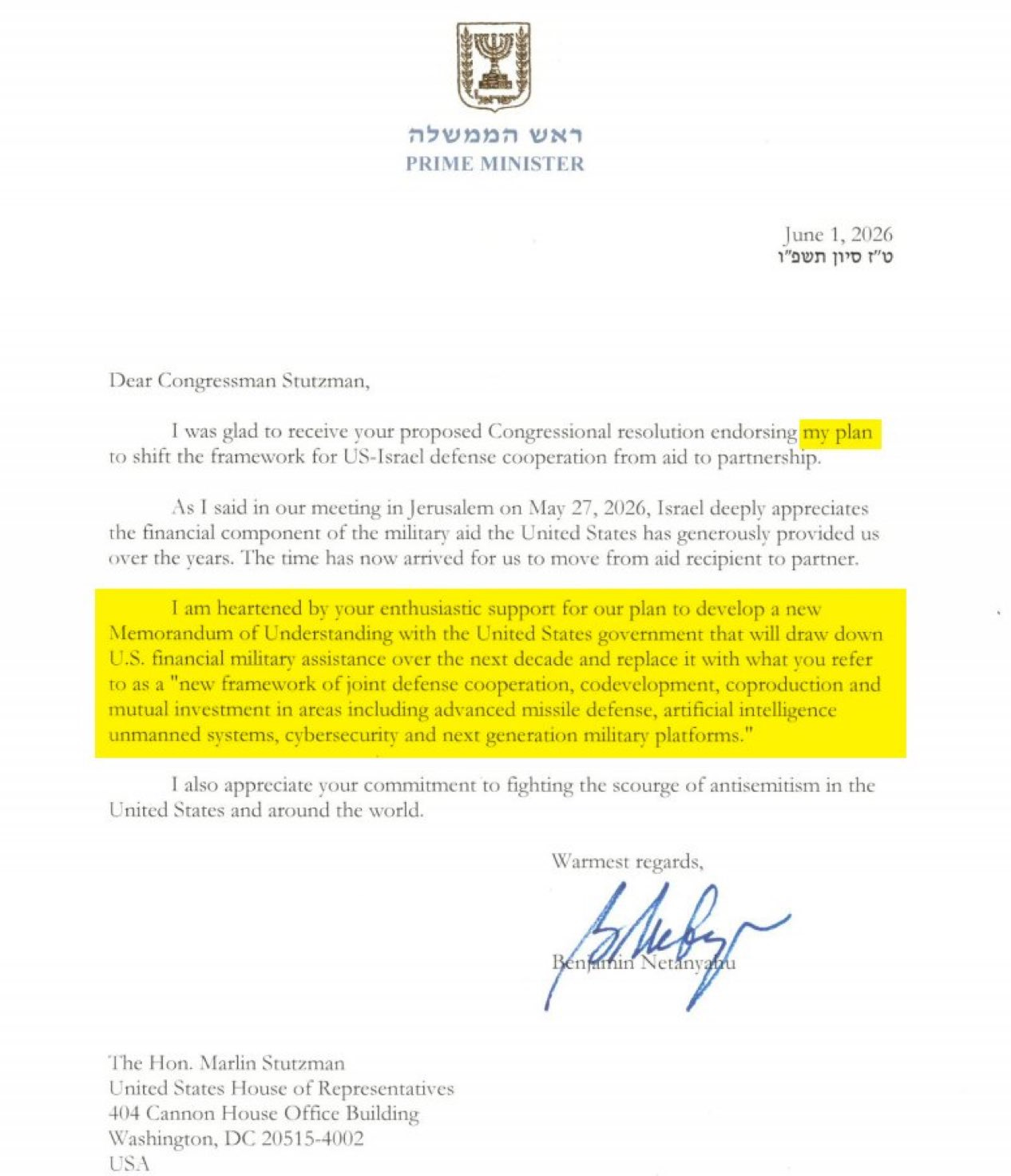
Netanyahu then went on Fox News where he said “I'm calling it from aid to partnership … the meshing of our two great countries would strengthen the military battlefield in many important ways.”
The Congressional Calculus
An amendment was introduced last month by Rep. Ro Khanna (D-CA), supported by Rep. Thomas Massie (R-KY), that would have stripped the USITCI from the House version of this bill.


It was rejected.
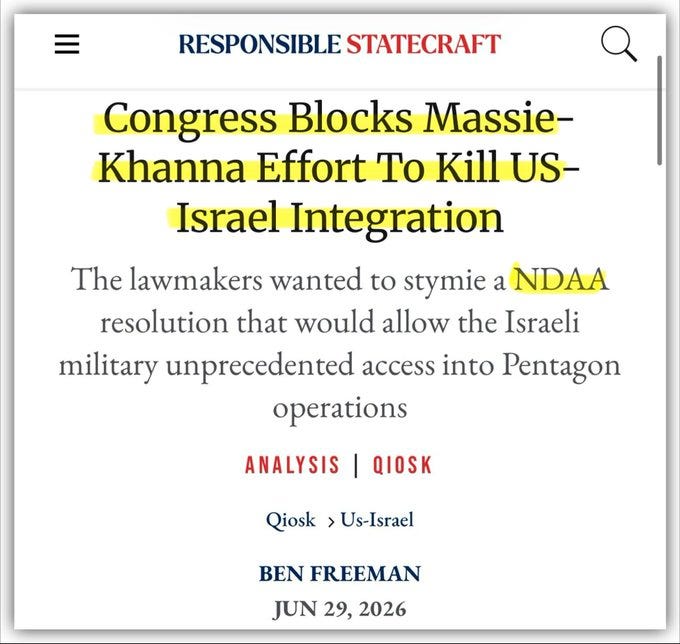
Or, more accurately, Khanna & Massie’s amendment was never even allowed to come to a vote. It was never allowed to reach the House floor. The House Rules Committee declined to make it in order, preventing any floor debate or vote. Nor did the amendment receive substantive consideration in committee.

Below are the members of the Rules Committee that blocked the amendment from receiving a vote. The committee is chaired by 83-year-old Rep. Virginia Foxx (R-NC):



On July 23, 2026, the House passed the NDAA by a narrow 216–212 vote. The result fell largely along party lines, with a handful of defections:
6 Democrats voted YES along with 210 Republicans
7 Republicans voted NO along 205 Democrats


The House will likely vote once more after its version is reconciled with the Senate bill in conference. Barring an unexpected development, however, the House outcome appears largely settled.
The more difficult battle will be in the Senate.
The Senate Calculus
Republicans hold 53 Senate seats. Assuming every Republican votes yes, they will need at least seven Democrats to reach the 60-vote cloture threshold required to advance the bill.
Senate Democrats already blocked the bill once last week:


Republicans responded by bundling the NDAA with the SAVE Act, which would require proof of citizenship to register to vote in federal elections.


By bundling these two bills together, Republicans are effectively issuing an ultimatum: if you want voter ID, you must also accept the merger of the Pentagon and the IDF. It is a cynical attempt to bully fiscal or Israel-skeptical conservatives into supporting a bloated, Israel-designed defense bill by branding anyone who votes against it as an opponent of voter ID.
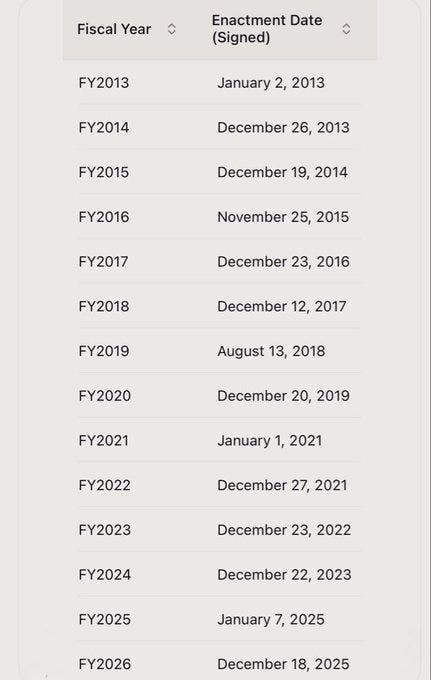
Expect the Senate battle to continue for several months as Republican leaders negotiate with Democrats and holdouts within their own party. There is little urgency to reach an immediate agreement: Congress rarely sends the final NDAA to the president before November. The chart below shows when the NDAA has passed in previous years:
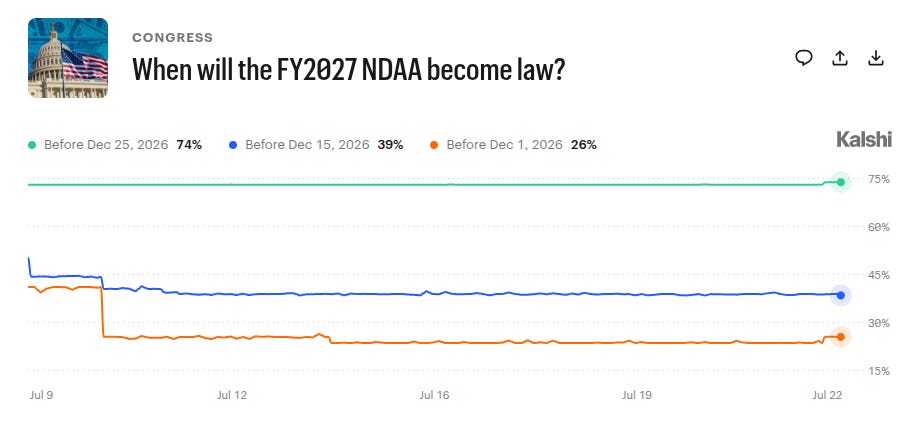
Prediction markets currently expect the bill to pass in December.
Conclusion: Treason
The billions Israel already receives in direct military assistance are at least visible. Congress appropriates the money, the press can identify it and the public can oppose it. This bill would replace that visible pipeline with something far more dangerous: a gateway into the entire Pentagon budget. What is now counted as foreign aid could be scattered across weapons programs, research contracts, procurement accounts and joint military initiatives until no one can say where American defense spending ends and Israeli subsidy begins.
The arrangement is being smuggled through Washington inside a bill approaching a thousand pages. There was no standalone vote. The amendment that would have removed it was not even permitted to reach the floor. Meanwhile, America’s supposedly adversarial press has responded with near-total silence. If this provision were genuinely defensible, its architects would defend it in public. Instead, they are counting on Americans never discovering that it exists.
A government that quietly subordinates its military resources to the interests of a foreign state has betrayed the people it governs. Its defenders can call it cooperation, interoperability or strategic integration. The honest word is treason.


A republic this easily corruptible by money, cannot stand.
Next up : the outdoor defecation enthusiasts manage to start a US-Pakistan war