


Coups, collapses, and revolutions are usually framed as moral dramas: heroes and villains, tyrants and liberators, peoples rising against power. What receives less attention is the market for distressed assets that forms in their wake. When states fracture, assets do not vanish. They are liquidated quietly, legally, and at a steep discount. Crisis creates opportunity, and into that vacuum move investors whose entire business model depends on chaos being just orderly enough to exploit.
In the language of global finance, these actors have a name: vultures.
They circle distressed states, wait for the moment of maximum weakness, then swoop in to buy debt and assets for pennies, only to extract full value later through courts, sanctions, or political leverage. Or, in this case, at gunpoint.
Towering over the vulture ecosystem is one figure more synonymous with the name “vulture” than anyone: billionaire activist Paul Singer, founder and CEO of a hedge fund called Elliott Management, which currently manages $78 billion worth of capital, making it one of the biggest hedge funds in the world. Forbes currently ranks Singer’s personal fortune as the 578th richest person in the world.
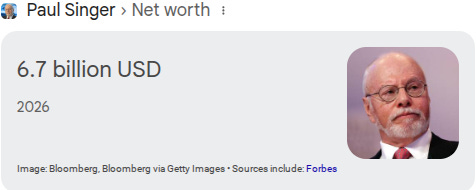
Singer has feasted on too many corpses for me to catalog in this article.
One prominent example, as described by Tucker Carlson in one of his stronger monologues below, is the tale of how Singer destroyed the small town of Sidney, Nebraska, by gutting their largest employer and selling it for parts (after donating the maximum allowable amount to Nebraska’s governor, of course):
“Feeding off the carcass of a dying nation is what Singer and his firm Elliott management have done in this country and to this country … Bloomberg News once described singer as “the world’s most feared investor” and that tells you a lot. No one’s even pretending Paul singers tactics are good for anyone but Paul Singer ... this kind of behavior it bears no resemblance whatsoever to the capitalism we were promised in school, it creates nothing, it destroys entire cities, it couldn’t be uglier or more destructive. So why is this so allowed in the United States? The short answer is because people like Paul singer have tremendous influence over our political process. Singer himself is the second largest donor to the Republican Party, he’s given millions to a super PAC that supports Republican senators. In Washington he is rock star famous, and that may be why he’s almost certainly paying a lower effective tax rate than your average fireman.”
Singer did the same thing in Detroit:

And in Korea.
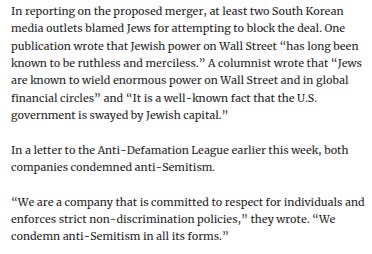
In 2015, as part of dispute between Singer and Samsung, Samsung published several cartoons of him as an anthropomorphic vulture on its corporate website.
The cartoons were denounced by Singer as antisemitic, and Samsung was forced to apologize to the ADL.
While Singer often targets private companies, such as in Nebraska, Detroit, or South Korea, his most notorious campaigns have involved bring entire nations to their knees. These include the Republic of the Congo (he filed at least fifteen separate lawsuits against Congo, at a time when they were in the middle of the worst food shortage in the world) and Peru (where, as former president Alberto Fujimori attempted to flee the country, Singer’s firm seized his jet). Most famously, Singer spent fifteen years in open conflict with the Argentine government over defaulted bond payments, a campaign that culminated in a $2.4 billion payout to his firm in 2016.
Which brings us to Venezuela.
How Paul Singer Stole Venezuela’s Crown Jewel
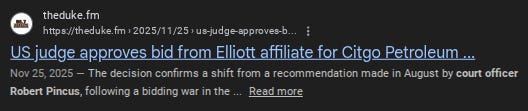
About a month ago, on November 25, 2025, a US judge approved the sale of Citgo Petroleum Corporation (CITGO), a subsidiary of Venezuela’s a state-owned oil company, to Amber Energy, a subsidiary of Paul Singer’s Elliott Management.
Venezuela rejected the legitimacy of the sale, with the Maduro administration calling it “fraudulent process,” a “barbaric theft, ”and “the theft of the century.”
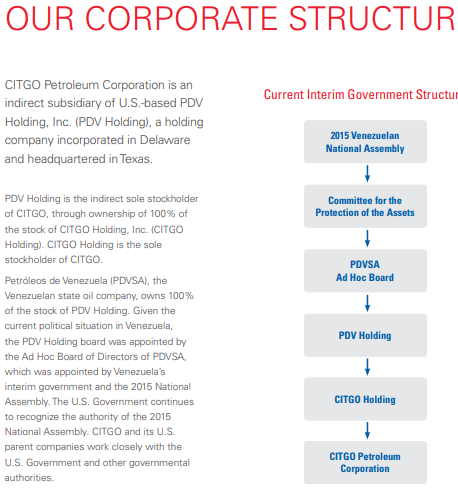
The sale price for CITGO was $5.9 billion, with the proceeds flowing to creditors of the Venezuelan state. The acquisition is expected to be finalized sometime next year, pending regulatory approval... Maduro was the obstacle blocking that approval, but now he’s gone.
On a fundamentals basis, CITGO is worth far more than what Singer paid for it. Valuations during the auction ranged from $10 billion to $20 billion, depending on methodology and assumptions. Evercore, the investment bank advising the court-supervised sale, placed CITGO’s value at roughly $13 billion, while the Venezuelan government has argued the company is worth north of $20 billion.
The reason CITGO sold for a fraction of its real value is simple: U.S. sanctions and non-recognition of the Maduro government made Venezuela radioactive to investors. Most serious buyers would not touch the asset. Financing dried up. The auction never became competitive. What should have been a sale turned into a clearance event, with one vulture left standing.
What great luck for Paul Singer, then, that only one month after his purchase was approved, Trump invaded Venezuela and turned it into a puppet state, declaring that all the oil now belonged to American investors!
This outcome was not an accident, and it was not the result of normal market risk. It was the product of a specific sequence. First, sanctions isolate a country financially and legally. Then creditors use U.S. courts to strip away sovereign protections. By the time assets are finally put up for sale, the original owner is boxed out, legitimate buyers have fled, and the only actors left are those who specialize in siege warfare. At that stage, price discovery is a fiction. The asset is no longer being sold. It is being harvested by parasitic vultures.
This is the terrain Paul Singer understands better than anyone alive. His business does not depend on growth, innovation, or productive investment. It depends on collapse that stops just short of total ruin. Courts must still function, nominally. Contracts must still bind. The state must be weak enough to surrender assets, but intact enough for judgments to be enforced. Venezuela, after years of sanctions and diplomatic isolation, met those conditions perfectly.
How Paul Singer Purchases Political Influence
Am I saying that Donald Trump invaded Venezuela for Paul Singer?
No.

Foreign policy is never driven by a single donor, and pretending otherwise would be unserious. Venezuela sits at the intersection of energy markets, regional power politics, sanctions regimes, the war on drugs, domestic U.S. electoral incentives, and long-standing ideological hostility to the Maduro government… Any intervention would have happened in a crowded causal field.
But that does not make Singer irrelevant.
It makes him unusually well positioned and influential.
Political donors like Paul Singer don’t need to micromanage strategies when those strategies already align with their interests. Instead, they strategically fund media outlets, think tanks, politicians, and campaigns to create an ecosystem where policies—such as framing military actions against regimes like Venezuela’s under Nicolás Maduro as moral imperatives—become legally enforceable and financially beneficial.
Here are 7 clear, distinct ways Singer exerts this influence:
Paul Singer owns the Washington Free Beacon — it’s his personal mouthpiece. In the month leading up to this week’s invasion, the Free Beacon published at least five articles portraying Maduro’s regime as a narcoterrorist threat linked to Hezbollah and drug cartels. This media barrage frames intervention as a security necessity, without disclosing that Singer, who is pushing the intervention, would profit billions.
Hezbollah, Short on Support From Iran, Turns to Drug Trafficking in Venezuela To Fill Its Coffers (December 23, 2025)
Bill Barr Defends Legality of Trump Boat Strikes and Describes Danger of Maduro Regime: Hezbollah’s ‘Anchor in Our Hemisphere’ (December 19, 2025)
Dealing With Maduro Is No Distraction. It’s a Necessity. (December 6, 2025)
Biden Admin Prosecuted Leader of Venezuelan Drug Cartel That Mainstream Media Now Say ‘Doesn’t Exist’ (December 1, 2025)
Ben Shapiro Savages Tucker Carlson’s Defense of Commie Drug Lord Nicolas Maduro (November 7, 2025)
“A September 2025 column criticized Columbian President Gustavo Petro for opposing foreign military intervention in Venezuela designed to oust Maduro.”
“An October 2025 piece by another Manhattan Institute analyst and a co-author praised Trump’s “consistent policies against Venezuela’s Maduro,” describing them as part of an effective strategy to eventually remove Maduro from power.”
“And a November 2025 article criticized Democrats for raising the alarm about Trump’s push for regime change in Venezuela.”
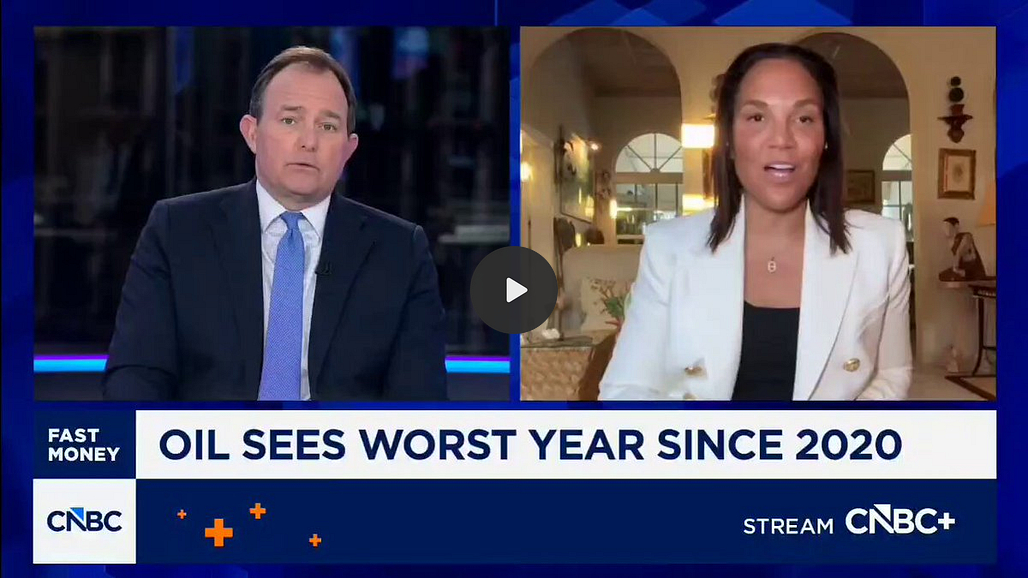
In March 2025, the Manhattan Institute hired a Venezuelan dissident dedicated full-time to tweet about how they need regime change to pump more oil:
 Daniel Di Martino 🇺🇸🇻🇪@DanielDiMartinoI agree, extract the oil. Government ownership of oil in Venezuela led to severe underproductiom and higher gas prices for all. These nutjobs think this is an own 😂
 Lycurgus @GC_StrategosWe should conquer and plunder Venezuela and all the other places these strange people crawl out from.10:55 PM · Jun 20, 2025 · 1.69K Views2 Reposts · 5 LikesDaniel Di Martino 🇺🇸🇻🇪@DanielDiMartinoSome of you seem to think we can just take the oil underground. No company will invest the billions required in Venezuela for a *decades-long* investment in oil without a transition to a safe and free country. Therefore, oil production simply *cannot* rebound under this regime.
 Brent Kulman @brentk56@DanielDiMartino So if it turns out that the only thing Trump wants is the oil and Rodriguez concurs with that but otherwise is left in power that doesn’t sound so great, no?3:32 AM · Jan 5, 2026 · 16.4K Views9 Replies · 33 Reposts · 219 LikesDaniel Di Martino 🇺🇸🇻🇪@DanielDiMartinoI have been asking President Trump on the record since at least 2018 to militarily intervene in Venezuela. This weekend, he did it. This is what I wrote in 2018 on the "Economic Benefits of American Intervention in Venezuela" for @ManhattanInst
 2:12 PM · Jan 5, 2026 · 9.44K Views7 Replies · 22 Reposts · 158 LikesDaniel Di Martino 🇺🇸🇻🇪@DanielDiMartinoOn @CNBC: If Maduro is overthrown in Venezuela, markets expect a huge increase in oil output... and decrease in oil prices.12:23 AM · Jan 1, 2026 · 12K Views2 Replies · 48 Reposts · 208 Likes
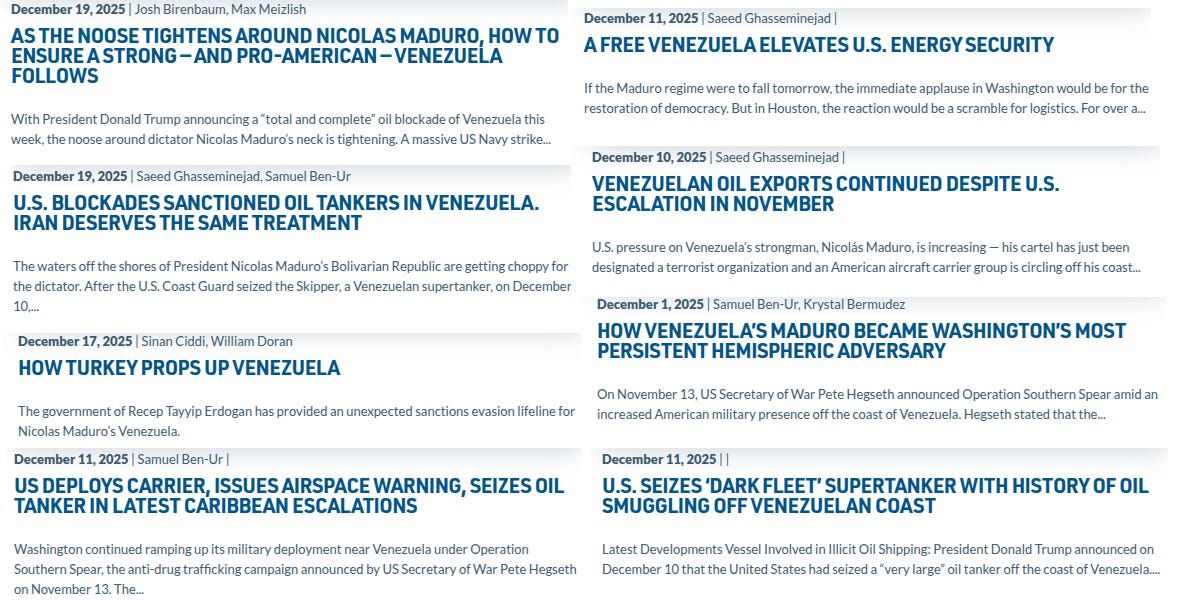
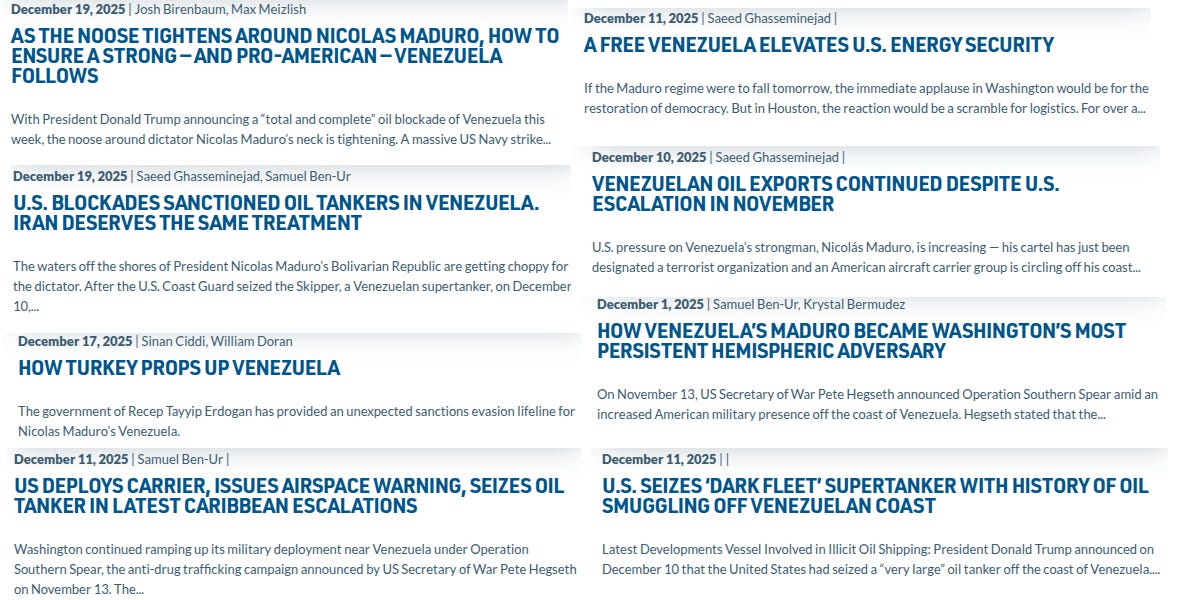
Singer is a major donor to the Foundation for Defense of Democracies. In the month leading up the invasion, they published 8 articles with such subtle titles as: "A FREE VENEZUELA ELEVATES U.S. ENERGY SECURITY.”
Paul Singer is currently funding (via a $1 million donation) a vicious primary campaign against Congressman Thomas Massie, who is “one of the most vocal opponents in Congress to Trump’s regime change push in Venezuela, joining Democrats to co-sponsor multiple failed war powers resolutions that would have reined in the president’s ability to launch military strikes against alleged drug boats in the Caribbean and launch an attack on mainland Venezuela.”
 Thomas Massie@RepThomasMassieAccording to Grok, Paul Singer, globalist Republican mega-donor who’s already spent $1,000,000 to defeat me in the next election, stands to make billions of dollars on his distressed CITGO investment, now that this administration has taken over Venezuela.grok.comSinger's CITGO Bid and U.S. Intervention | Shared Grok Conversation8:50 PM · Jan 4, 2026 · 439K Views2.61K Replies · 6.11K Reposts · 20.8K Likes
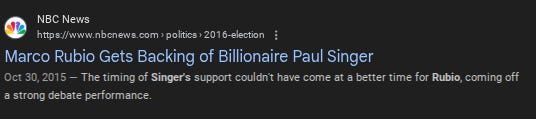
Singer has been one of Marco Rubio’s primary financial backers for more than a decade, helping elevate one of Washington’s most consistent advocates of sanctions and intervention in Latin America
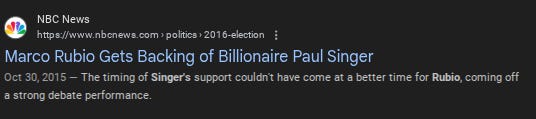
https://www.nbcnews.com/politics/2016-election/marco-rubio-gets-backing-billionaire-paul-singer-n454911 In 2024, Singer donated $5 million to Trump’s Super PAC, along with $37 million more to Trump’s allies, and $1 million to Trump’s inaugural fund. Singer has met personally with Trump at least four times.
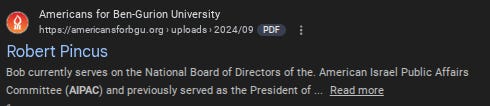
Paul Singer has donated a total of $3 million to AIPAC since 2022, making him tied for AIPAC’s third largest donor. This matters because the court-appointed special master who forced the sale of CITGO, Robert Pincus, sits on the board of directors for AIPAC.




Taken individually, these carefully curated relationships can be dismissed as ordinary political activity: a donor funding media, think tanks publishing white papers, senators advancing hawkish views, super PACs backing friendly candidates.
Taken together, they form something else entirely.
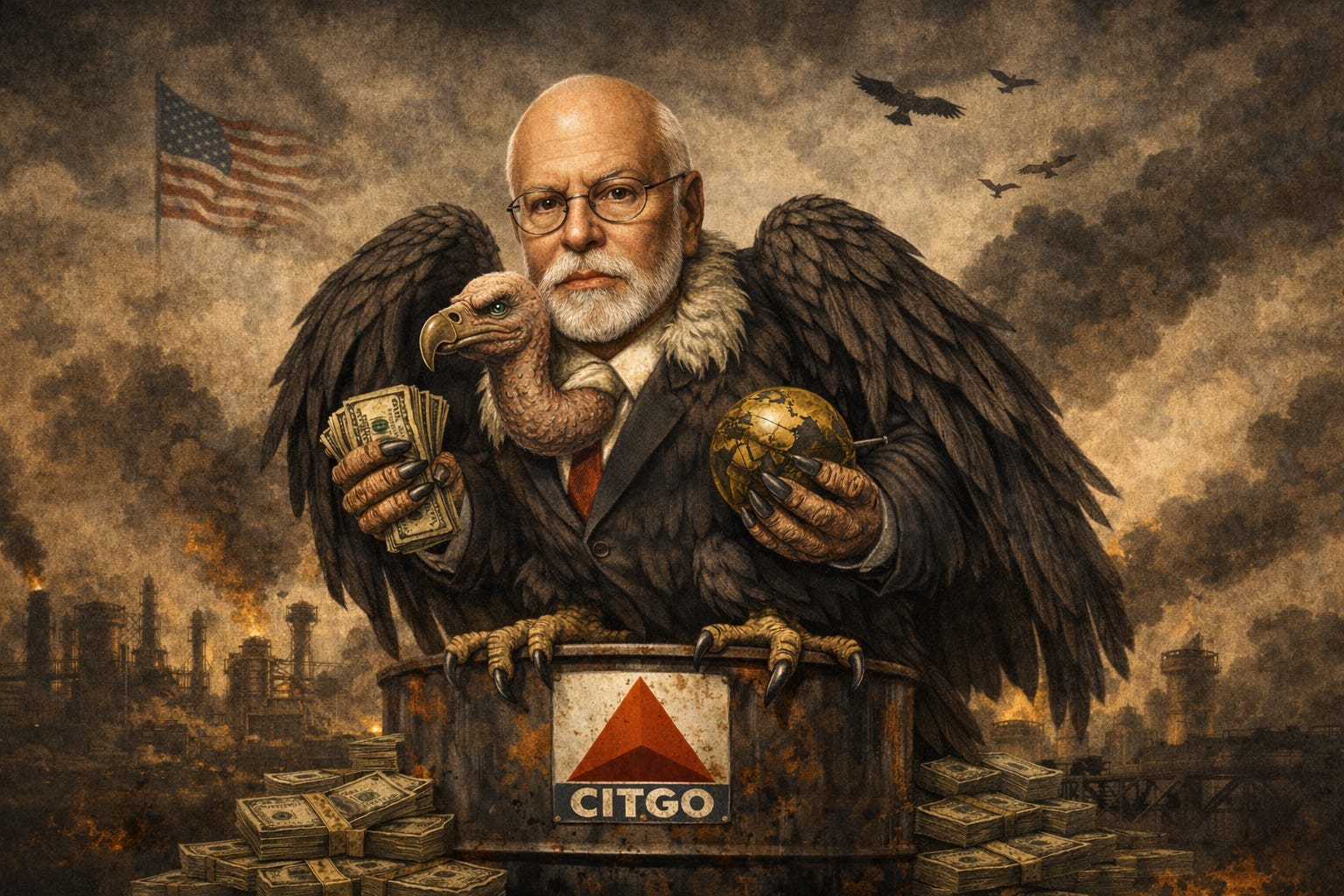
Paul Singer did not invent sanctions. He did not invent sovereign debt litigation. He did not invent regime change. What he perfected was the ability to profit from all three at once, while remaining legally insulated from the consequences.
CITGO was not lost because Venezuela failed to manage its assets.
It was lost because transnational capital wanted it, so they took it.
Straight gangsterism.
This is what vulture capitalism looks like at its apex. Not chaos; precision. Not theft in the dark; but seizure in broad daylight. The asset survives. The state does not. And by the time the sale is approved, the only remaining question is not whether it was just, but whether anyone still remembers who owned it in the first place.
Excellent work here. I wish more work like this were done on the financial ties linked to the Democrats as well.
I wholeheartedly agree with the other comments…excellent work as usual! Paul Singer is a new name for me, I suspect I’m not alone in this, and there’s definitely a special place in hell for folks like Singer.