


Bloomberg reported in 2023 that Acrisure —the world’s eighth-largest insurance brokerage, with $3.95 billion in revenue and 19,500 employees — had begun working with investment banks on a potential IPO.
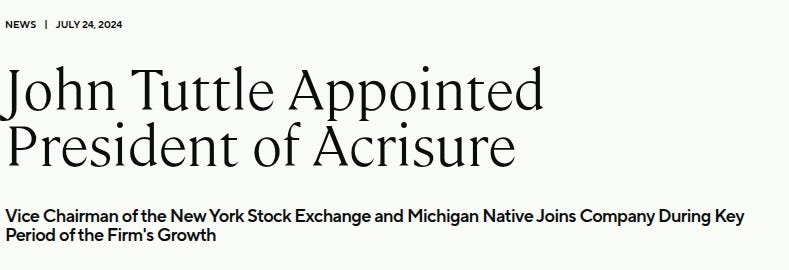
In 2024, Acrisure hired John Tuttle, the former vice chairman and global head of listings at the New York Stock Exchange, as its president. Tuttle had previously worked on more than 1,300 equity offerings.
In 2025, Acrisure raised $2.1 billion in convertible senior preferred stock through a funding round led by Bain Capital, valuing the company at $32 billion. The financing was explicitly structured around a future IPO.

As Acrisure prepared itself for Wall Street, it eliminated thousands of American jobs—and repeatedly blamed artificial intelligence and automation.
Dozens of mainstream news articles uncritically accepted this explanation at face value, parroting Acrisure’s line that they are an AI-powered fintech innovator whose AI prowess had rendered their American workforce obsolete.
My investigation points to a far more conventional explanation: Acrisure is shifting work once performed by American employees to lower-cost operations in India, the Philippines, and Colombia.
The word for this is “AI washing.” Much like “greenwashing,” AI washing allows companies to wrap conventional corporate behavior in the language of technological progress. Instead of admitting that jobs are being eliminated because the work can be performed more cheaply overseas, executives describe the cuts as an unavoidable consequence of artificial intelligence.
For a company preparing to go public, the AI narrative is far more attractive. “We outsourced thousands of jobs to India” sounds like conventional cost-cutting. “We used artificial intelligence to transform our workforce” sounds like innovation, and encourages investors in the IPO to value the company as a fintech platform rather than merely another insurance broker.
I reached out to Acrisure for comment:
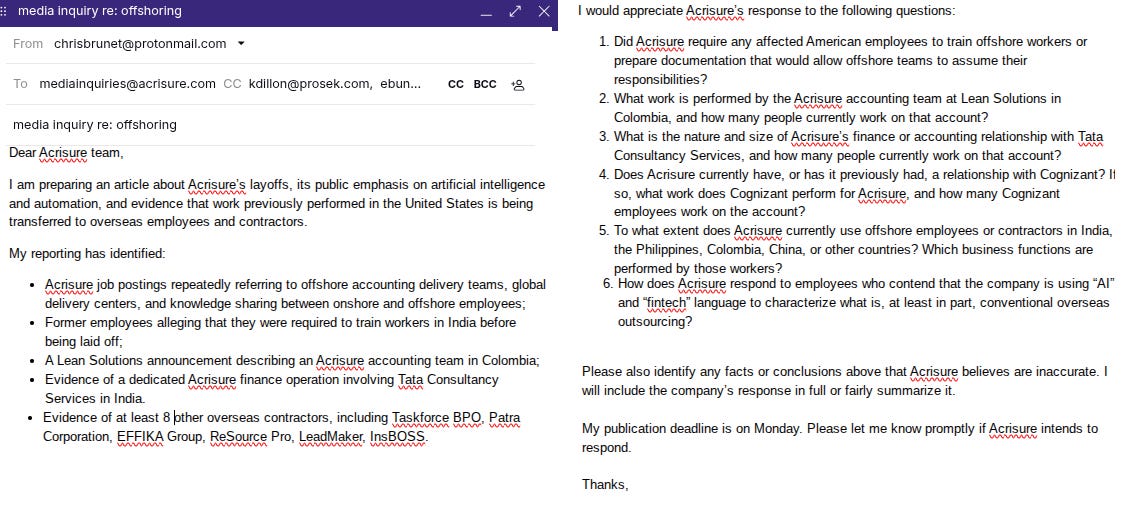
An Acrisure spokesperson repeatedly told me they would answer my questions, and then only provided the following bland statement:
“Acrisure is proud to be a U.S. based global business with well over 10,000 employees in the U.S., which is the majority of our workforce. We are strongly committed to delivering world class service to our clients across all 50 states and 20 other countries. Advances in automation, AI and digital platforms are essential for every leading company, and the implementation of these technologies is an important component to providing the exceptional solutions that our clients expect and demand. Beyond that, it’s our policy not to comment on our specific day-to-day operations, including proprietary information.”
Next, I reached out to Michigan state Rep. Josh Schriver, who represents the 66th House District. He provided me with the following statement:
“If Chris Brunet’s reporting is accurate as the employee accounts and evidence strongly suggest, Acrisure is replacing American workers…not with AI…but with cheaper laborers from India.
One American worker sold out for cheap foreign labor is one too many.
This isn’t just a Michigan problem. It’s happening to American workers coast-to-coast.
If you are anywhere in America, you should call on your representative right now. Contact your federal representatives and your state legislators immediately. Demand real coordination to shut down these parasitic visa programs (H-1B, L-1, and the rest) that let companies import lower-wage replacements instead of hiring and training American talent. We must always put American workers first.”

The First Round of Layoffs
Eight months ago, Acrisure announced 400 initial layoffs in their accounting department, citing advances in “technology” and ”automation” and “AI.”


Acrisure is headquartered in Grand Rapids, and, immediately, Acrisure employees on the r/grandrapids, /Accounting, r/InsuranceAgent subreddits began grumbling about the *real* reason:


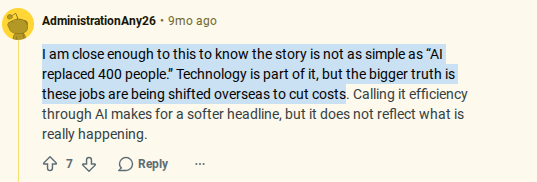

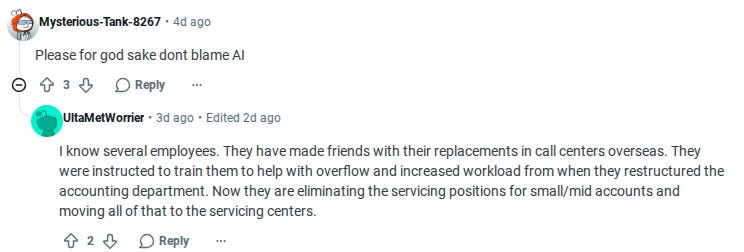


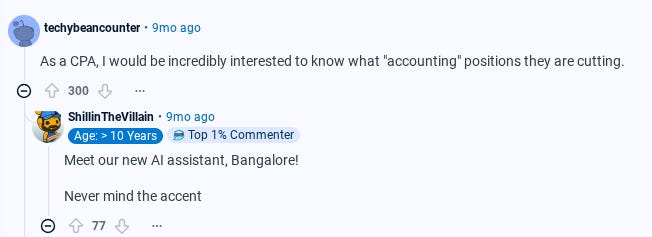
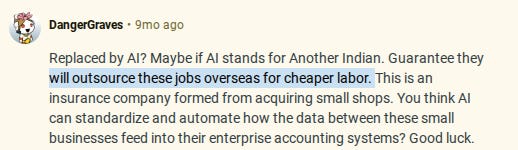
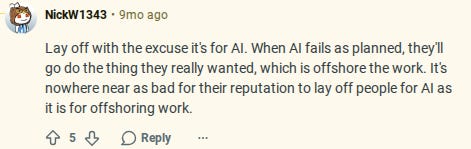
The same grumblings appeared on TikTok, LinkedIn, and Facebook:
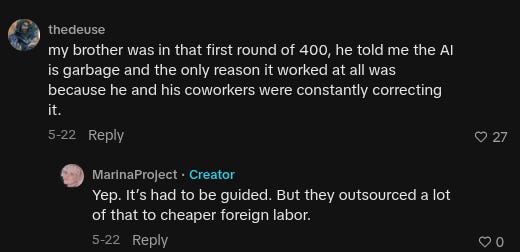
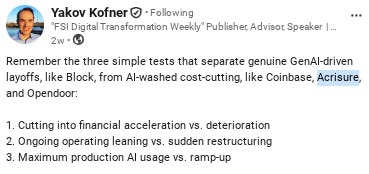
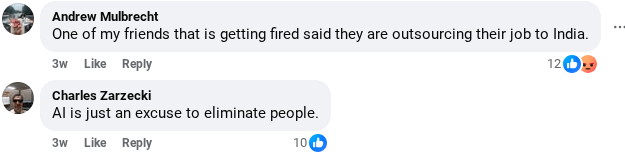
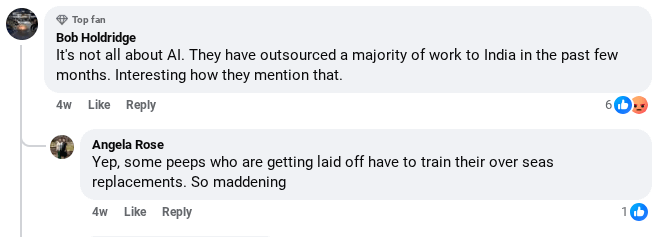
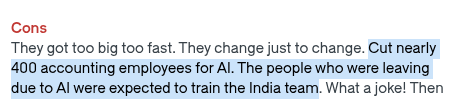
On Glassdoor and Indeed, ex-Acrisure employees told the same story via reviews:
“The people who were leaving due to AI were expected to train the India team.”
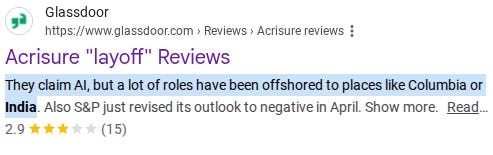
“They claim AI, but lots of roles have been offshored to places like India.”
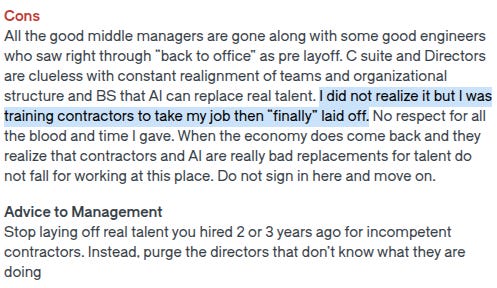
“I was training contractors to take my job then finally laid off.”
“Stop laying people off because of “AI” when you’re just offshoring the work.”

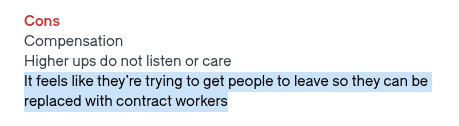
“It feels like they’re trying to get people to leave so they can be replaced with contract workers.”
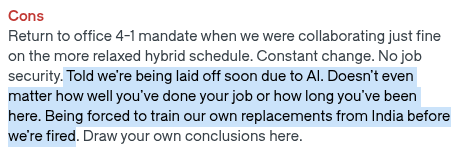
“Told we’re being laid off due to AI. Being forced to train our own replacements from India before we’re fired.”
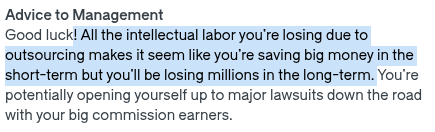
“…outsourcing…”
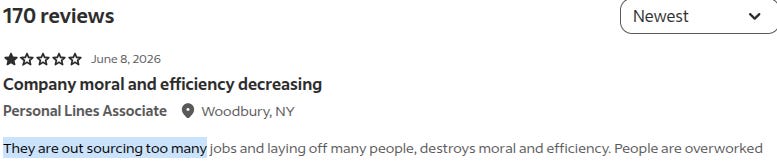
“They are outsourcing too many jobs, destroying morale and efficiency.”
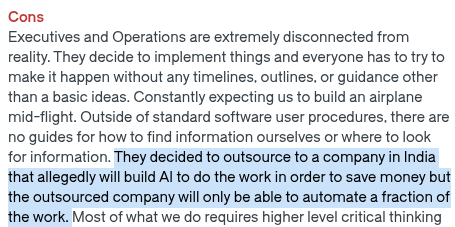
“They decided to outsource to a company in India that allegedly will build AI to do the work in order to save money but the outsourced company will only be able to automate a fraction of the work.”
“There is no amazing “fintech”. It is smoke and mirrors.”

“I’ll be glad to quit this embarrassment of a “fintech” company".

“Not even remotely close to being a Fintech.”
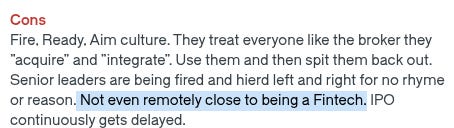
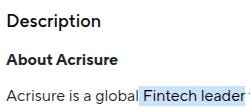
These quotes are especially damning for a company that describes itself in the first line of their “About” page as a “fintech leader” in preparation for an IPO.
Still, anonymous employee reviews are not conclusive.
I need a smoking gun.
Let’s start with a recent job posting for “Specialist - Cash App & Receivables” :
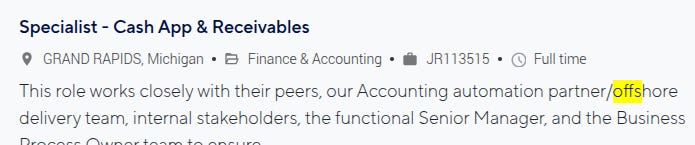
The job duties mention “offshore accounting delivery teams” 6 times:
This role works closely with their peers, our Accounting automation partner/offshore delivery team
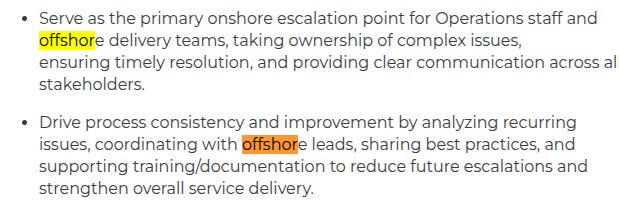
Serve as the primary onshore escalation point for Operations staff and offshore delivery teams
coordinating with offshore leads
Develop and maintain strong relationships with Accounting automation partner/offshore delivery team
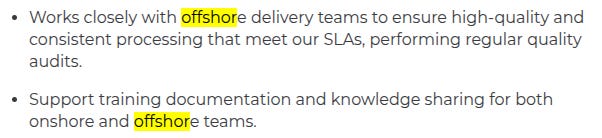
Works closely with offshore delivery teams
We can now be sure that Acrisure’s accounting unit was offshored.
When a company prepares to offshore a department, the overseas workers do not yet possess the institutional knowledge required to perform the specific, day-to-day tasks of the Americans they are replacing. Software can be deployed overnight; institutional knowledge cannot. In the corporate language of offshoring, “knowledge transfer” and “knowledge sharing” are euphemisms for when American employees are ordered to write manuals, record step-by-step walkthroughs, and conduct Zoom training sessions to train the offshore workers who will take their jobs.
The same “Specialist - Cash App & Receivables” job hints at precisely that “knowledge transfer” or “knowledge sharing” process:
“Support training documentation and knowledge sharing for both onshore and offshore teams.”
The same language appears across many other postings for accounting jobs — for example, a “Specialist in Producer & Broker Commission Payables” role mentions “offshore delivery teams” 4 times, including “knowledge sharing”:

Another accounting post, “Director - Premium Payables”, lists “offshore” 6 times:

“managing both onshore and offshore teams”
“managing global teams in offshore delivery centers”
“provide functional leadership to offshore teams within the Accounting & Finance Operations team.”
“Champion change management to ensure smooth adoption of new processes and systems across onshore and offshore teams
“Experience leading large, high performing teams (ideally a mix of onshore and offshore/captive/outsourced teams)”
“overseeing day-to-day operations managed by teams onshore and offshore for NA Retail and Specialty business (supports approximately 60% of Acrisure revenue)”
A Senior Director, Digital & Systems Operations posting says the ideal candidate should understand “offshore/nearshore delivery strategies.” It also included a dedicated section called “Vendor & Offshore Relationship Management,” with responsibilities to “manage offshore support teams” and to “develop and execute strategies that leverage outsourcing, offshoring, and hybrid delivery models to improve cost and service performance.”

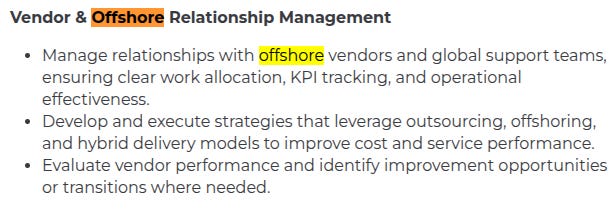

Across these jobs, Acrisure repeatedly describes Americans as the “onshore escalation point” who provide “functional leadership” and “knowledge sharing” to “offshore workers” at the “Accounting Global Delivery Center” where the actual day-to-day accounting functions take place.
In the course of my investigation, I identified at least 9 offshore contractors with publicly available evidence of having worked with Acrisure.
Taskforce BPO (Macedonia)
Patra Corporation (India & Philippines)
EFFIKA Group (Uzbekistan)
ReSource Pro (China, India, Philippines)
LeadMaker (Philippines)
InsBOSS (Philippines)
Lean Solutions (Colombia)
Tata Consultancy Services (India)
Cognizant Technology Solutions (India)
Drilling down further, I identified the two specific contractors to which Acrisure outsourced accounting work.
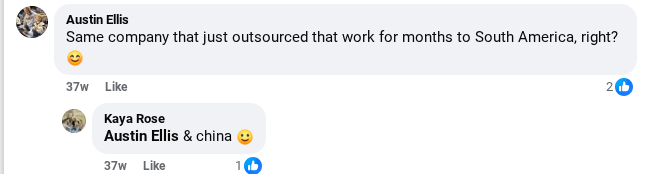
The first is Lean Solutions, in Colombia, which, in the months following the 400 layoffs in Grand Rapids, boasted about “growing our Acrisure Accounting team to 101 people”.

The Colombia evidence actually appears broader than the 101-person accounting team. Lean Solutions personnel publicly describe separate Acrisure West, Southwest, and Accounting teams, and a Lean manager advertised for insurance and data-entry staff specifically “to support the Acrisure account.”

Acrisure is also outsourcing some accounting functions to Poland. However, the Poland-based employees replacing American financial-accounting staff appear to be employed directly by Acrisure rather than through a third-party contractor.
They were all hired in the months following the American layoffs.



The main firm taking American accounting jobs is Tata Consultancy Services.
Tata’s entire business model is to take over a client’s finance department and move it to India or the Philippines to drive "cost reduction in core processes."
Tata established a dedicated “Acrisure finance unit” in the months after Acrisure’s U.S. accounting department was scheduled to be phased out in Q1 2026.
My sources tell me that Tata’s “Acrisure finance unit” has about 400 people.
Hilariously, all Tata contractors in Nagpur, Maharashtra, have pronouns in bio.
The second location involved is Pune, India.
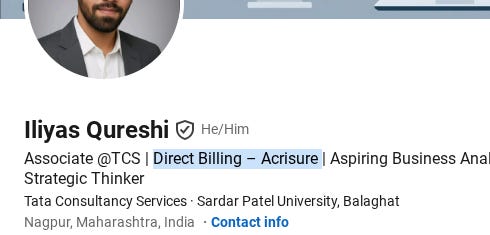
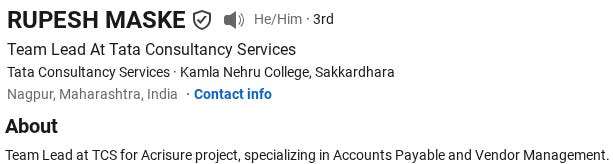
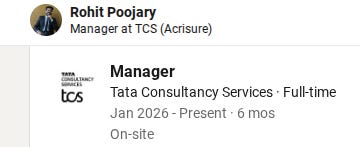
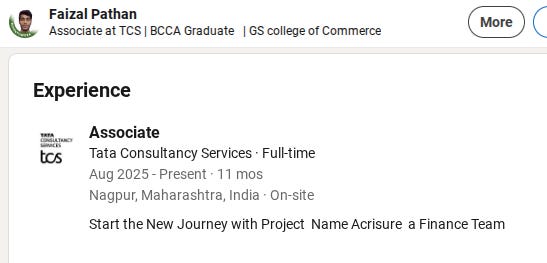


Beginning in January 2026—just as Acrisure’s eliminated American accounting positions were scheduled to disappear—Tata Consultancy Services launched a sustained hiring campaign for insurance-accounting workers in Nagpur, India.
At a January 3 “Mega Walk-In”, TCS recruited “Accounts Payable—Premium Payable” workers to reconcile direct-bill commissions from insurance carriers, modify broker commission rates, track carrier payments and investigate discrepancies. A January 10 recruitment drive simultaneously sought workers for Record-to-Report, Premium Payables and Accounts Receivable–Billing. TCS repeated the hiring on January 24, recruiting separately for premium payables and insurance billing, then advertised the same billing role again on February 14, emphasizing a preference for “immediate joiners.” On April 10, TCS held another Nagpur drive for experienced accounts-payable and accounts-receivable workers.
Applicants were expected to know Applied Epic—the exact same insurance-management software used by Acrisure—and work American hours.

This is apparently the building in Nagpur where accounting work once performed in Michigan by Americans is now being transferred:

Tata’s $168 Million Insurance-Platform Case
TCS has used a similar insurance offshoring strategy before—and just last week, the Supreme Court declined to review a $168 million judgment arising from it.
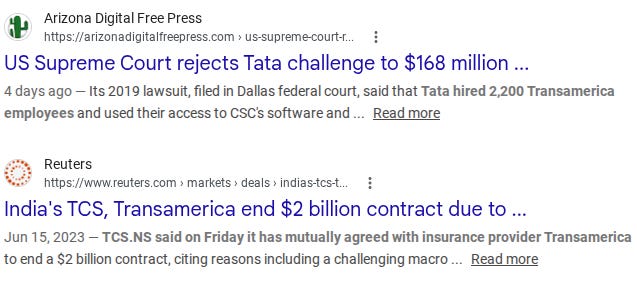
In that case, TCS took over Transamerica’s life-insurance operations and absorbed more than 2,000 of its employees. Federal courts found that some of those workers transferred proprietary source code and technical materials to TCS’s offshore personnel, helping the company accelerate development and migration work for its competing offshore platform.
The Supreme Court’s refusal to hear TCS’s appeal left in place approximately $56 million in compensatory damages and $112 million in punitive damages.
The case does not establish misconduct at Acrisure. But it clearly maps out the immense regulatory, security, and operational risks that materialize when an American insurer’s internal database knowledge, systems, and client data are fast-tracked into TCS’s offshore delivery network.
The Second Round of Layoffs
In May 2026, Acrisure announced a much larger round of 2,250 layoffs—equal to 11 percent of its workforce—to be implemented across its U.S. operations. This is the largest single-employer 2026 layoff in the insurance brokerage subsector. From what I understand, 1000 of the layoffs are through 2026 and 1,200 or so through 2027.
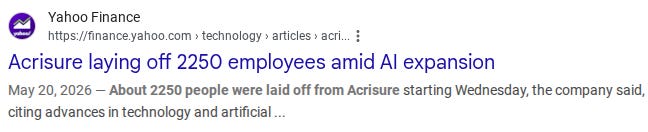
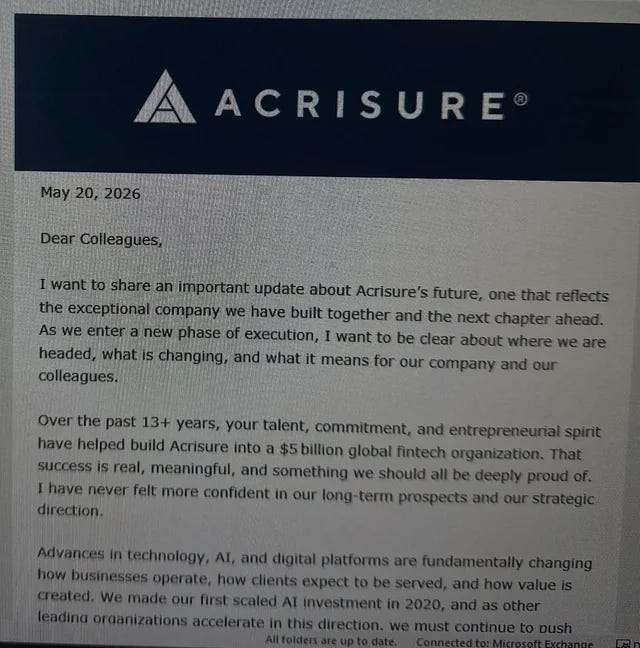
My anonymous sources say Acrisure internally refers to this round of layoffs as “Project Bradshaw,” while the earlier accounting layoffs were code-named “Project Greene.” The names follow a football theme tied to Acrisure’s $150 million naming-rights deal for Acrisure Stadium, home of the Pittsburgh Steelers: Terry Bradshaw and “Mean” Joe Greene are two of the most famous players in franchise history.

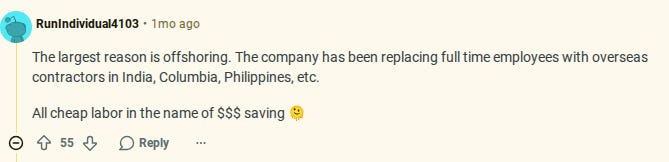
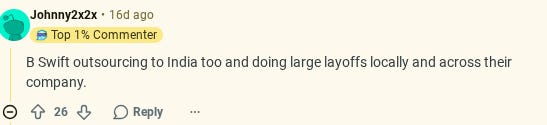
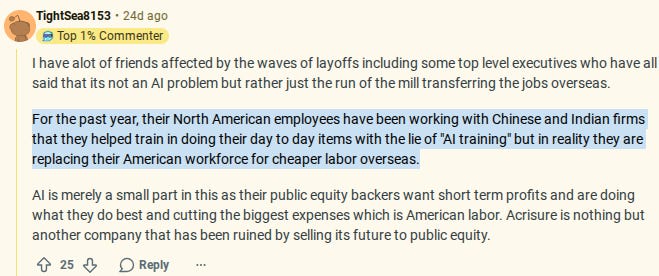
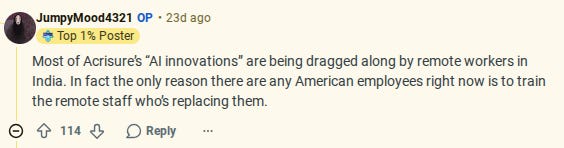
Again, disgruntled employees took to the /r/GrandRapids subreddit, complaining about having to train their overseas replacements:
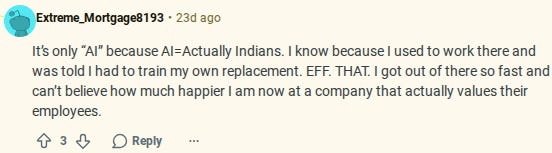
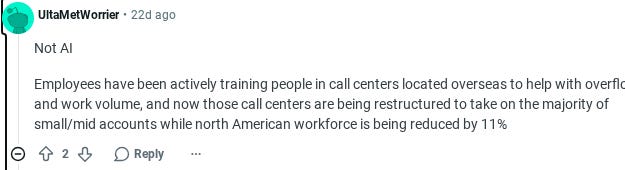





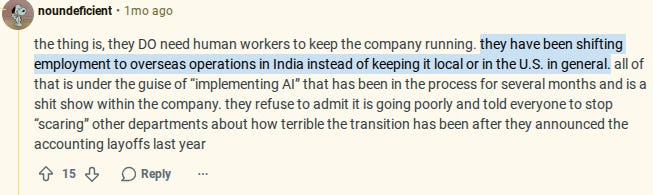
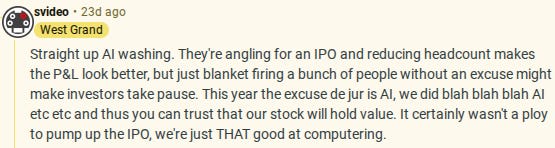
I tried to speak with Acrisure employees on the record for this article, but nobody was willing. They are all terrified. One anonymous employee told me:
“Acrisure has already had their litigation attorney call and threaten some of my colleagues advising that they signed a non-disparagement agreement and none of them can talk for a year. They’ll find any loophole to sue or cause problems for anyone who speaks against the Acrisure name. I [know people who have] already been threatened by their litigation attorney to not mention Acrisure in a negative light. It’s disgusting they let people go and make them sign a hush agreement.”
Fortunately, there was no need to persuade employees to speak on the record. After the second round of layoffs, dozens of frustrated Acrisure workers took to Facebook with their real names and described publicly what they said was happening inside the company:
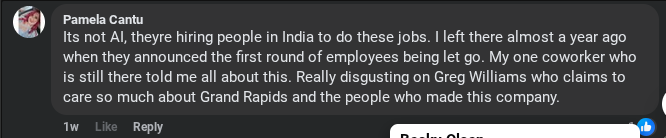


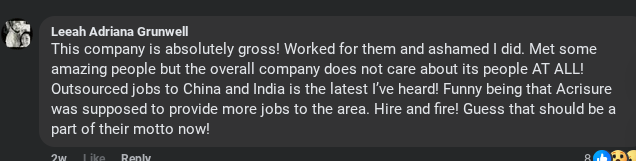
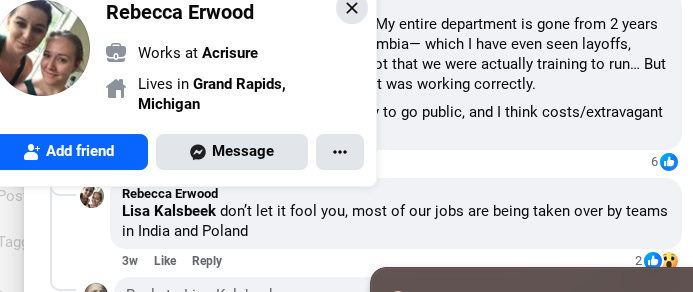
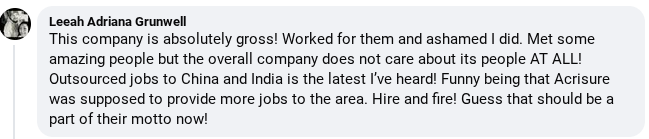

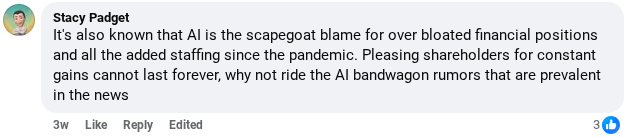

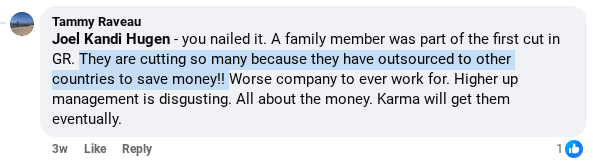

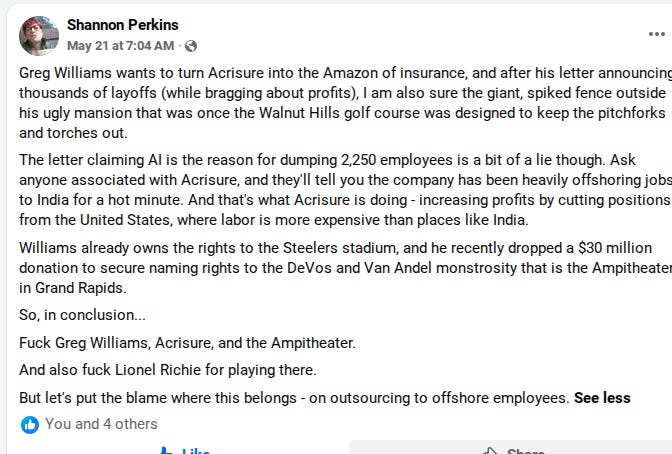
The primary beneficiary of “Project Bradshaw” layoffs, my sources say, is Cognizant.


Acrisure and Cognizant do not appear to have publicly announced their relationship, and I have not located a contract explicitly identifying Acrisure as Cognizant’s client. But Cognizant’s recent hiring activity provides remarkable corroboration: the timing, software, job functions, and locations all closely match the work Acrisure is now eliminating across its American operations.
The Amphitheater Whitewashing
Acrisure announced its latest layoffs just five days after the opening night of the Acrisure Amphitheater, downtown Grand Rapids’ newest entertainment venue.

Acrisure paid $30 million for the naming rights.


There is no evidence that Acrisure deliberately timed the layoff announcement to coincide with the amphitheater’s opening. Still, the timing was remarkably convenient. The opening generated precisely the publicity the company would have wanted to overshadow the layoffs: ribbon cuttings, Lionel Richie, civic celebration, and repeated praise for Acrisure’s commitment to Grand Rapids.

The juxtaposition is a PR disaster.
Acrisure Amphitheater was built with a $30 million State of Michigan grants and city-issued bonds whose debt service is funded through Kent County hotel-tax revenue.
Likewise, when Acrisure moved its headquarters to Grand Rapids, it received $7 million in economic incentives. As part of the incentive package for that public subsidy, Acrisure committed to create and maintain 400 new, high-paying jobs in Michigan.
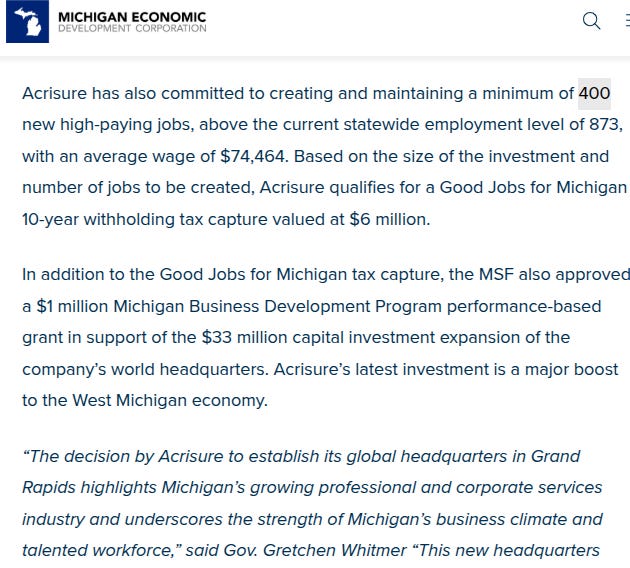
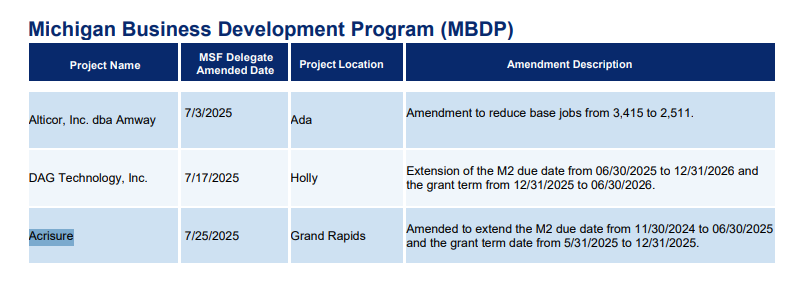
That grant expired at the end of 2025… exactly when Acrisure fired 400 people.
Also in December 2025, the CEO of Acrisure announced a record $401 million commitment to Michigan State University, $100 million of it to literally buy 10% of their football team’s revenue-generating operations. The new MSU president and athletic director who orchestrated this deal then just abruptly left.

The point is not that Acrisure was obligated to give that money to employees, or that Acrisure cannot purchase naming rights while cutting costs.
The point is that Acrisure plainly had hundreds of millions of dollars available for prestige projects, stadium branding and college athletics. Against that backdrop, it is deeply unseemly for the company to accept public subsidies intended to create Michigan jobs, then eliminate those jobs and transfer them to India.
Conclusion: The IPO Story
On April 1, 2026—seven weeks before the 2,250 additional layoffs—S&P Global Ratings changed Acrisure’s outlook from stable to negative.

The numbers explain why. Acrisure’s adjusted leverage had risen to 9.6 times EBITDA by the end of 2025, up from roughly eight times the previous year. Its adjusted EBITDA margin had fallen from 27 percent to 21 percent, placing it among the lowest-margin insurance brokers rated by S&P. In North America, its organic growth had slowed to just 1 to 2 percent.
“[Acrisure] have to respond more aggressively and more quickly because they’ve got to manage their debt loans,” says Kevin Stipe, CEO of insurance brokerage consulting firm Reagan. “Because PE firms generally use debt, then it is fair to say that they have to respond to some of these things more quickly and sometimes more strongly. But I think the key part of the story is that growth is slowing for brokers.”

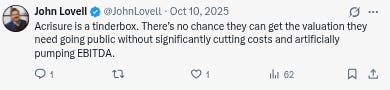
Acrisure has grown extraordinarily quickly, but not primarily by inventing revolutionary insurance technology. It grew by acquiring a vast number of independent, small-to-midsize insurance agencies and consolidating them under a common corporate umbrella.
Through that acquisition spree, Acrisure’s revenue grew from $38 million in roughly 2013–2014 to about $4 billion by 2023—an increase of approximately 105-fold in ten years.
“Fintech” always made me laugh. It’s literally an acquisition firm lmao.
That roll-up model works beautifully while acquisitions keep producing headline growth. But eventually the company must prove that the collection of agencies it assembled can generate stronger organic growth and wider margins on its own.
By 2026, Acrisure was under pressure to do exactly that.
The company had spent years positioning itself for an eventual public offering. It hired John Tuttle, the former global head of listings at the New York Stock Exchange, as its president. It raised $725 million in preferred equity at a $23 billion valuation in 2022, followed by $2.1 billion in convertible senior preferred stock at a $32 billion valuation in 2025.
Those securities are not ordinary shares that can be sold on a public exchange. Private-equity investors, executives and potentially some owners of businesses acquired by Acrisure hold private company equity whose value cannot readily be converted into cash without an IPO, a company sale or a secondary transaction.
There is public evidence that Acrisure has at least sometimes used its own stock as acquisition currency. That matters because many insurance-agency owners spent decades building their businesses before selling them to Acrisure. To the extent that sellers accepted Acrisure shares, rollover equity, earnouts or other equity-linked consideration, part of the price they received for their life’s work remains illiquid—effectively “locked” inside a private company.
A great deal of supposed wealth therefore exists as Acrisure paper. Until a liquidity event occurs, that paper cannot easily be converted into cash.

An IPO would force investors to decide what Acrisure actually is: a conventional insurance brokerage assembled through thousands of acquisitions, or an automated fintech platform capable of generating software-like margins.
That distinction could be worth billions of dollars.
The incentives are therefore straightforward:
Acrisure expanded too fast.
Margins had deteriorated.
Leverage was extremely high.
Acrisure was positioning itself for an IPO.
Offshore labor could reduce operating costs (“window dressing”).
The “AI” narrative could persuade Wall Street to award Acrisure a technology premium rather than value it as a vanilla private-equity roll-up, thereby artificially inflating their upcoming IPO by billions of dollars.

If you are a whistleblower, email me: chrisbrunet@protonmail.com
Please share this article widely.
This really hits home for me. Just witnessed the same at my own company and involving one of the vendors your article mentioned.
I’ve seen this trend of companies citing AI but in truth just mean they are going abroad for labor.
It is honestly warming myself up to AI tech because I think a lot of the concerns over its labor impact are kind of fake; it is an excuse to hire Indians.