


Immediately after I published my video, “Cambridge Professor Found Dead After Rampant Plagiarism and Pattern of Deception,” the story took another turn.

Just hours later, Nathan Cofnas, the postdoc who first brought Jason Arday’s plagiarism allegations to widespread public attention, announced that his own university was investigating him for allegedly discriminating against Arday.


Only a few hours later, Ghent University formally suspended him.
Cofnas said the university would “almost certainly fire me.”
The suspension letter objects that Cofnas called Arday “mentally disabled” and a “worthless scholar,” described his efforts as a “crusade,” and allegedly engaged in a “targeted campaign of professional elimination.”
“The manner in which you publicly presented your role in the allegations concerning the late professor Jason Arday has reinforced concerns among the university’s community that your public interventions seem to develop into targeted campaigns of professional elimination.”
“Furthermore, in several public interviews, you repeatedly referred to the late professor Jason Arday as being ‘mentally disabled’ and made various other disparaging remarks concerning him, including, among others, describing him as a ‘worthless scholar’.”
“By framing your interventions as a ‘crusade’ aimed at the systematic personal and professional destruction of colleagues, you have demonstrated that your actions extend beyond the permissible bounds of academic debate.”
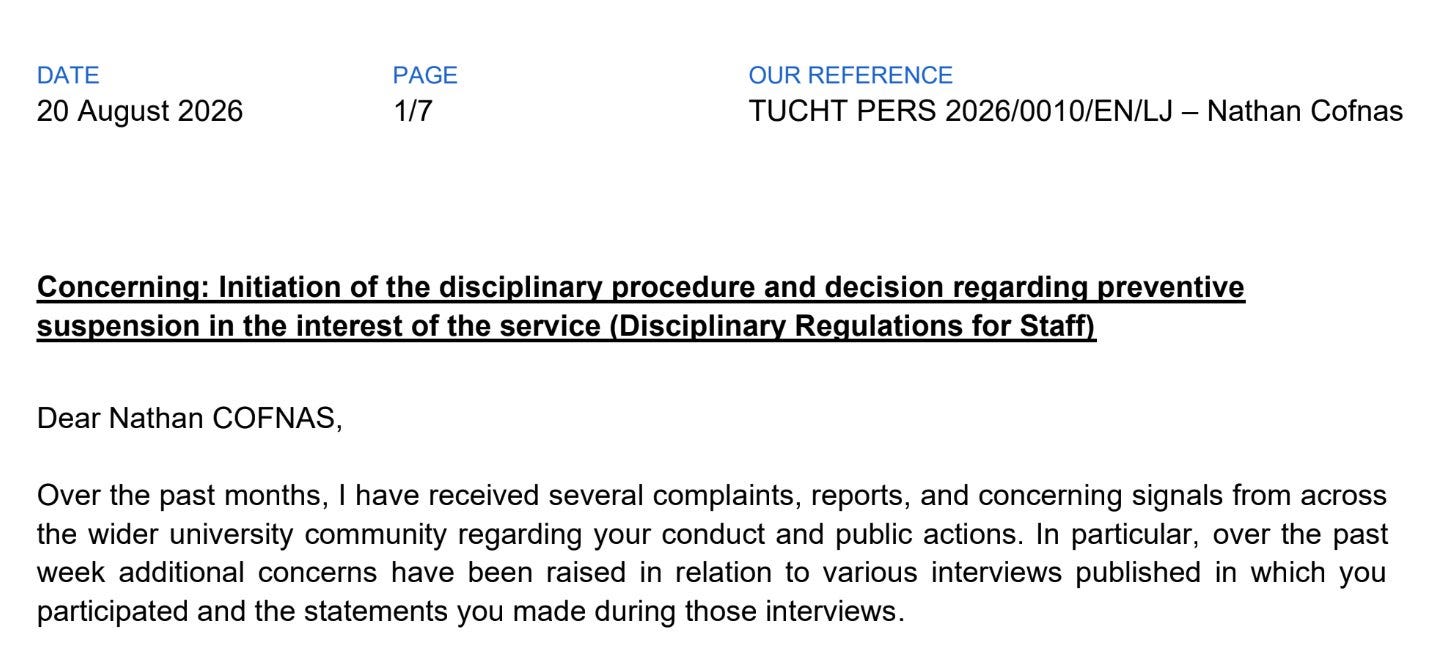
Ghent does not accuse Cofnas of fabricating evidence, forging documents, or making false claims about Arday. Instead, the suspension letter focuses on his tone, motives, and the backlash his reporting provoked: student petitions, staff complaints, more than 100 emails, and claims of psychological distress.
That creates an obvious perverse incentive.
The more successfully activists can generate outrage around a controversial scholar, the stronger the administrative case becomes for removing him. It is a version of the heckler’s veto: enough people object to your presence, therefore your presence itself becomes the problem.
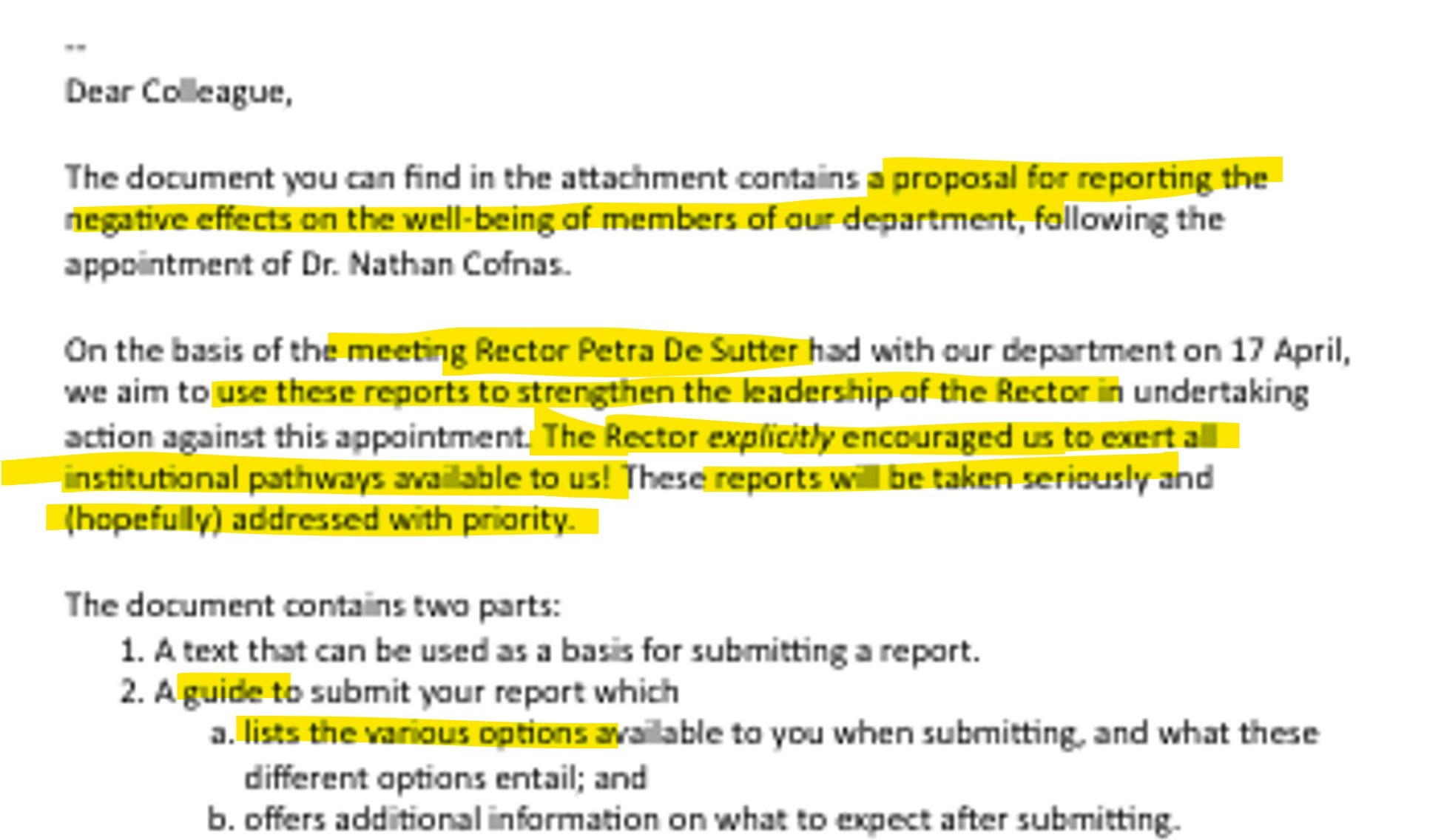
An internal email circulated by a tenured professor in Cofnas’s department makes the situation look even stranger. According to the email, Rector Petra De Sutter had explicitly solicited members of the university community to submit complaints. Classic. Encourage people to complain about an employee, then point to the number of complaints as proof that the employee must be removed.
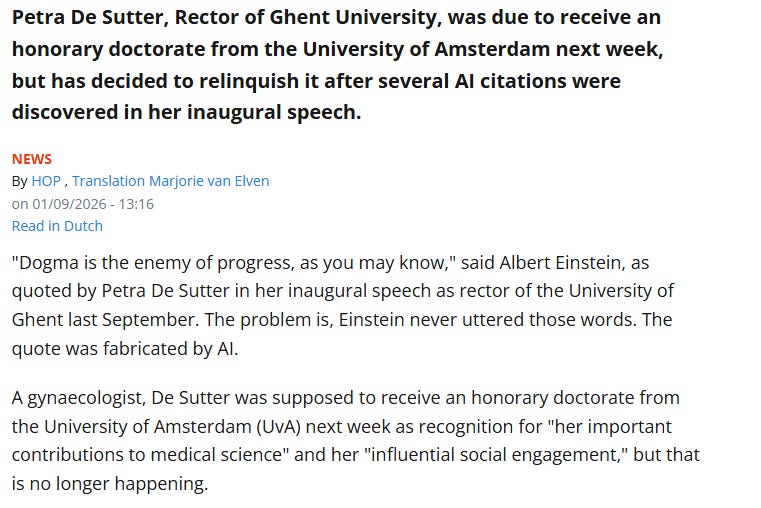
Cofnas then turned his attention to De Sutter personally, accusing the rector of using AI-generated material containing fabricated quotations in a speech.
This allegation is undeniably true.
What I find amusing is Cofnas’s careful use of the pronoun “she.”
He’s apparently on a crusade for truth, but even while accusing his own rector of dishonesty, he is scrupulously respectful of “her” gender identity.
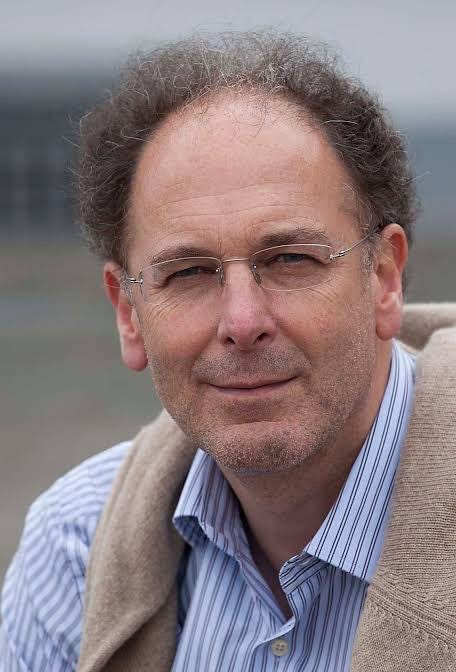
If we look closer, Petra De Sutter looks suspiciously like a man wearing a wig:
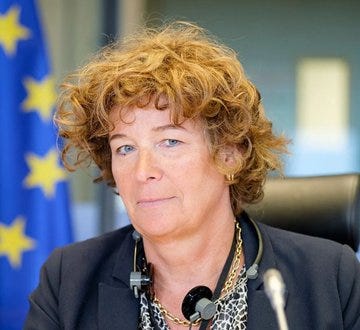
Before transitioning around age 40, Petra De Sutter published professionally as Paul De Sutter, a gynecologist.

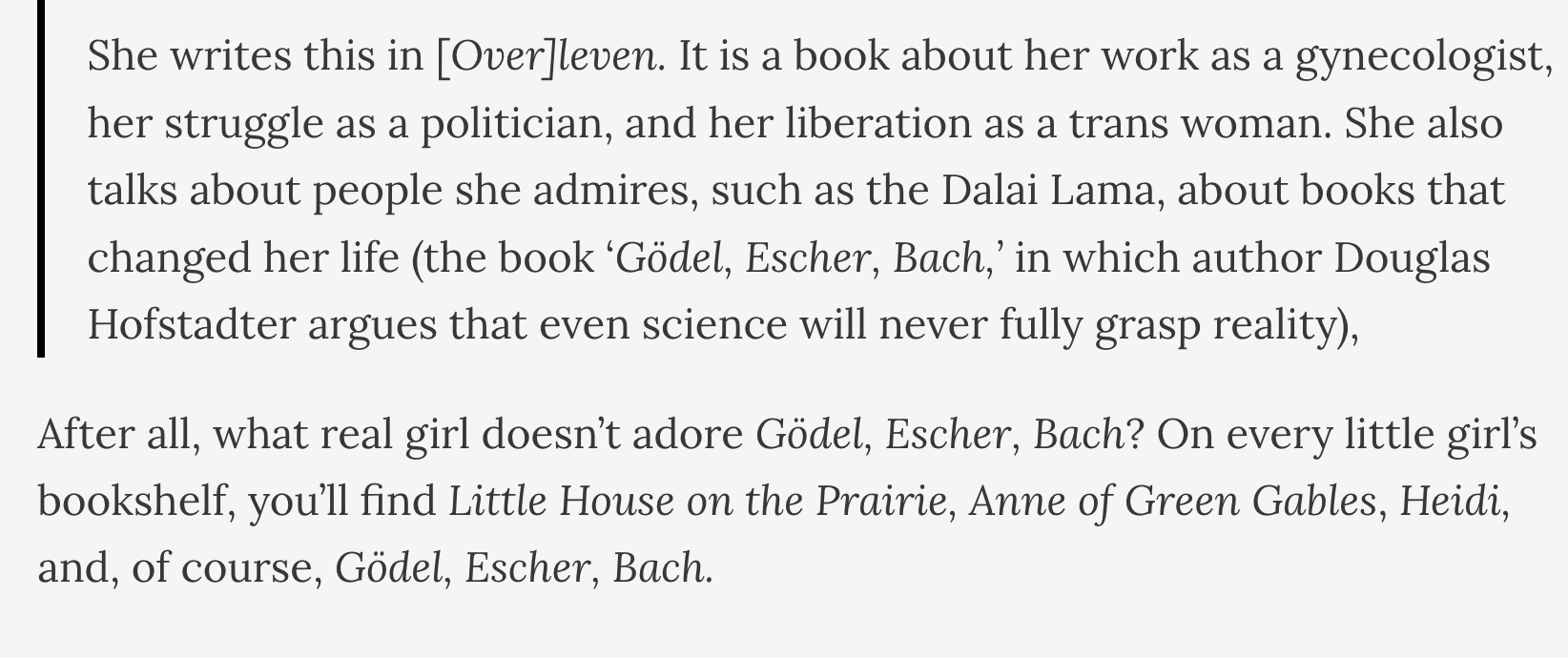
De Sutter recounted his transition in the 2016 autobiography Over(leven): mijn strijd als transvrouw, arts & politica (“Surviving: My Struggle as a Trans Woman, Doctor & Politician”).
In a 2018 TEDx Brussels talk titled “Tele-Babies,” he portrayed gene editing and reproductive technology as a moral imperative, citing eugenicist Julian Savulescu and casting Aldous Huxley’s “Brave New World” as something to aspire to.


"In the world of Aldous Huxley, procreation is not something that is connected with sexuality or with relationship or family-building anymore. You just go to a clinic or a factory, if you wish, and you give your gametes. After so many months, you can pick up your child, which has been genetically enhanced and designed according to the features that you want."
Very creepy.
The backlash has now gone international.
Today, August 21, U.S. Ambassador to Belgium Bill White personally intervened, urging Ghent University to ensure that Cofnas remains employed. The U.S. Embassy denounced the university’s treatment of Cofnas as “scapegoating mob behavior,” and warned that the university’s access to U.S. funding could be at risk.
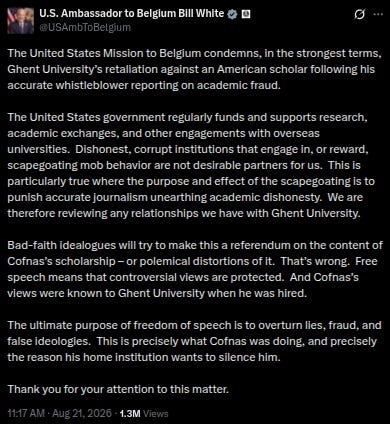
“The ultimate purpose of freedom of speech is to overturn lies, fraud, and false ideologies. This is precisely what Cofnas was doing”
Good for the Trump administration. If America is going to project its values around the world, academic freedom is a pretty good place to start.
Whatever else you think of Trump, this is a concrete example of how differently his government is willing to use power. It is impossible to imagine a Kamala Harris administration going to the mat for Nathan Cofnas; if anything, the political incentives would have pointed in the opposite direction; they would be twisting the knife in his gut. Instead, the Trump State Department has put the weight of the U.S. government behind an academic whom almost every conventional political actor would regard as too radioactive to defend.
The ball is squarely in the Belgian government’s court.
Your move, Brussels.
Watch the video I made about this:
I would like to know : Why does a Belgiu
m University get USA funding in the first place?
Arday himself claimed to be a mute autistic that didn't learn to read until 18. I think "mentally disabled" is the technical term for such a person, don't you think?